When Carl Wazen, Katlego Maphai, Lungisa Matshoba and Bradley Wattrus decided to start Yoco together around 2013, they did not have a polished business plan or a grand vision for building a payments company. They only had a problem they could not ignore.
“We were all at this stage of our lives where we wanted to do something that had more meaning,” Wazen, Yoco’s chief business officer and co-founder, recalled.
Wazen and Maphai met while working at the telecommunications consulting firm Delta Partners. Maphai and Matshoba had known each other since childhood and university, while Wattrus had worked with Maphai at Rocket Internet, a global venture-building company, in Nigeria.
South Africa was moving towards card payments. Between 2010 and 2014, card-payment transactions almost doubled, from 1.02 billion to 1.96 billion, while cards in circulation rose from 58 million to 90 million. But small businesses were being left behind. For many, accepting cards meant navigating banks, paperwork, fees, and hardware designed for larger companies.
The founders believed there had to be an easier way for small businesses to accept card payments without navigating a banking system built around the needs of larger, more established companies.
That simple idea became Yoco, officially launched in October 2015 after a year-long beta involving more than 500 merchants. It started with a small card machine and has since grown into a technology platform serving 200,000 small businesses.

But getting there required the founders to persuade a bank to trust four people with no payment track record, convince investors to back a non-existent business, and repeatedly reinvent the company as merchants’ needs changed.
“There was an entire year in which we were sitting on 90 days of runway at any moment in time,” Wazen told TechCabal in an interview. “And constantly, that was my only job. I was fundraising the entire time, on a plane, trying to find investors.”
All four founders remain with Yoco, but in different roles. Matshoba leads product and technology, Wattrus oversees finance as chief financial officer, while Wazen continues to run the business side as chief business officer. Maphai, who stepped down as CEO in 2025, remains involved as a strategic adviser.
“For us, it didn’t feel right that you had this disadvantage as a small business owner that was capping your growth relative to a more established business,” Matshoba said of the company’s founding.
The problem looked obvious, but solving it was not.
Yoco’s first product was a small card machine that could sit on a shop counter and let a small business accept cards already in its customers’ wallets.
But behind that simple device was a far more complicated challenge of banking partnerships, risk and trust.
The founders had no intention of competing with South Africa’s well-developed banking sector by building another bank. Instead, they wanted to use a small card reader and software to bring card payments to businesses the traditional payment system had largely ignored.
At the time, a small business wanting to accept cards had to deal with a bank, work through a lengthy application, and take on hardware and fees that made card acceptance impractical. Yoco stripped that burden away.
With the startup, a merchant could sign up quickly, get a small device, and start accepting cards without going through a process built for companies far larger than theirs.

Before Yoco could do all this, it had to solve its biggest problem. The startup could not simply plug its card machine into South Africa’s payments system and start processing transactions. It needed an acquiring bank—the institution that enables merchants to accept card payments—to connect it to the card networks and process transactions on its merchants’ behalf.
Yoco needed one to provide its route into the card networks and, crucially, to trust the startup to acquire and manage a new population of merchants.
That was a difficult proposition for a commercial bank. Yoco had no trading history, customers or track record in payments. The bank had to assess not only whether four young founders could build a viable product but also whether they could identify legitimate merchants, manage risk, support those merchants and operate within the rules of the payments system.
“We spent our entire first year trying to convince a bank to take us on as a partner,” Wazen said
He likened the arrangement to a mobile virtual network operator, where a smaller telecoms company uses a larger one’s infrastructure and licence to deliver specialised services to its own customers.
In many respects, Wazen said, the bank was taking Yoco on as a single merchant while allowing it to aggregate a much larger group of businesses underneath that relationship.
“We had essentially built a business on paper in a lot of detail, and we had to convince the bank that it was a credible business plan,” he said. The plan covered merchant acquisition, risk management, operations, and customer support.
The fundraising problem was just as difficult. Yoco was trying to raise money before it had a product in the market or meaningful traction, and local venture capital firms were sceptical. In 2015, Maphai said local VCs had turned the company down because it had neither a trading history nor a licence.
Its first $560,000 round came largely from angel investors, with Wazen drawing on his professional networks in the Middle East. Early backers included fintech investor Robby Hilkowitz and Greg Kidd, who joined as an early funder and adviser.
Institutional money was a different problem. As Wazen put it, the company was caught in a “chicken-and-egg situation”: it needed to show it could raise money to secure the banking partnership, while the bank wanted reassurance that Yoco had sufficient financial backing.
Mercantile Bank broke the deadlock. The smaller South African commercial bank approved Yoco’s application and agreed to partner with the startup, giving it access to the payments system through the bank’s acquiring infrastructure.
Then the institutional investor that had already issued a term sheet pulled out after the bank approved the partnership. Wazen did not disclose the reason. The timing left Yoco holding the banking relationship it needed to operate and missing the investor it expected to finance the next stage.
“We were wondering, ‘Do we tell our angel investors what happened? Do we tell the bank what happened?'” Wazen said.
The founders kept going. The bank had already taken a bet on them, and the angel investors chose to increase their commitment. “All the angel investors stayed. They even decided to double down even more to take up the full stake,” Wazen said.
That gave Yoco enough capital to start building the product and onboarding its first merchants, with no institutional lead. The founders handled sales, onboarding, and customer support themselves, doing what Wazen calls “the things that don’t scale.”
“We were all doing onboarding. We were all doing sales,” he said. “Even when we had a team, we stayed very hands-on when it came to the customer experience, because that’s all we had.”
Wazen said the product was designed to be simple enough that merchants needed no formal training, and word of mouth built Yoco’s first merchant base in Cape Town before the company expanded to other cities.
When the model started working
There were several moments when the founders realised Yoco might have found something that could scale.
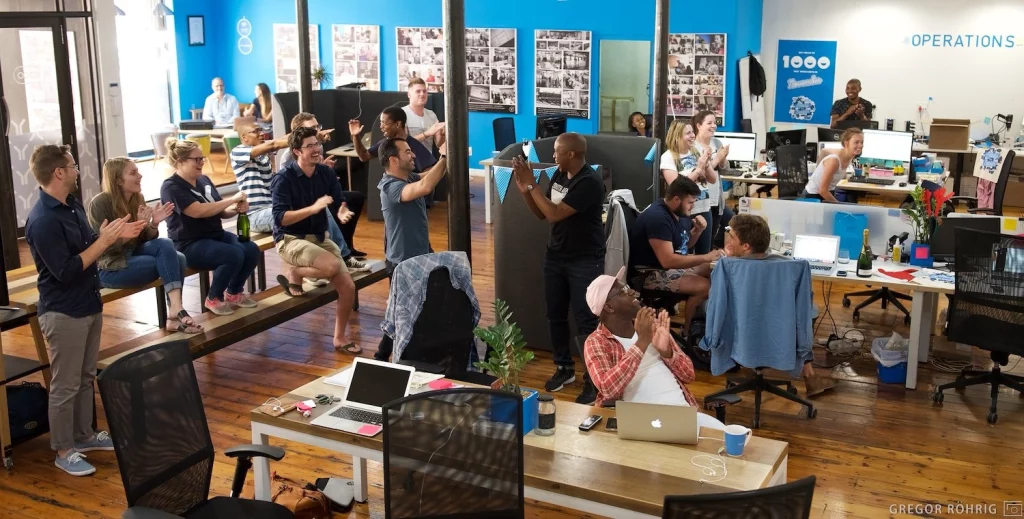
One came in 2016, when Yoco grew from roughly 500 merchants at the start of the year to 5,000 by the end.
“That was a 10x growth year,” Matshoba said.
Growth became more systematic as digital marketing, inbound sales, and self-service onboarding worked as a repeatable engine. Once the founders believed they had cracked that loop, they set more aggressive targets. In July 2016, Yoco aimed to add 400 new merchants in a month, nearly three times its previous high of 150. It hit the target. By November, it was adding more than 800 a month.
In 2019, the company launched Yoco Go, a smaller, cheaper card machine built to bring card payments within reach of more small businesses. The response was immediate. Yoco signed up 15,000 merchants in a single month, according to Matshoba, showing how much demand remained among businesses it had not yet reached.
For a payments company serving small businesses, COVID-19 was more than another difficult period. When South Africa entered lockdown, businesses across the country scaled back or suspended operations, sending turnover and transaction volumes sharply lower. Yoco felt the shock through the businesses on its platform, with transaction volumes falling by about 90% at the height of the lockdown.
“Transaction numbers dropped, and we were quite shocked,” Wazen said.
Yoco eventually found an opportunity in the data it was collecting. With businesses, government, investors, and the media struggling to understand the economic impact of lockdown, the company published figures showing how transactions had fallen and built a live dashboard tracking the recovery by province and industry. The data helped Yoco understand what was happening to its customers while also becoming a public resource.
The market at stake was substantial. By 2020, South Africa had an estimated 2.6 million formal small, medium and micro enterprises (SMMEs), and the Department of Small Business Development put the number of micro and informal businesses at roughly 3.3 million. The estimates varied depending on how small businesses were defined and pointed to the scale of the market Yoco had spent years building.
Matshoba said the crisis tested something deeper than the company’s ability to react. The global narrative at the time held that physical commerce might permanently give way to online shopping. Accepting that would have meant questioning the market Yoco had spent years serving.
“We fundamentally believe that the street is the incubator for any business, especially small businesses,” Matshoba said. “If everything becomes digital, you start to get into the world of large corporations.”
The company moved quickly to support merchants through the disruption, launching an online payments product and adapting as businesses shifted between physical and digital commerce.
“We had to make a lot of highly customer-sensitive decisions during that time to make sure that our customers constantly had the right products and had our backing,” Matshoba said.
Becoming bigger than payments
Yoco began with a simple proposition: make it easier for small businesses to accept card payments. Then payments created another opportunity.
Once a merchant’s transactions were digitised, information about sales, customers, and business performance could support other services. Point-of-sale software, business tools, and financial services could sit around that original payment relationship.
“What we didn’t realise that early was how quickly after launching our payments product we would feel the pull from customers for the rest of it,” Matshoba said.
Merchants wanted fewer systems and less complexity. They did not want separate providers for payments, point of sale, and the rest of the in-store experience. Accepting a card was one part of running a business; they also needed tools to manage sales, orders, products, and daily operations.

In 2020, Yoco expanded from the card machine into point-of-sale software, online payments, and other business and financial services, turning a payment relationship into a broader set of tools. The idea was to give small businesses one place to manage more of their commerce instead of stitching together several systems.
“You’ve got to stay very close to what the customer needs the most from you,” Wazen said.
Surviving over a decade
The South African startup ecosystem Yoco entered was far smaller and less established than the one it operates in today. Over the decade, the country has become one of Africa’s major startup funding markets, with South Africa among the continent’s “Big Four” markets consistently attracting the bulk of venture investment.
The ecosystem Yoco entered in 2013 was far smaller than the one it operates in today. In 2025, South African startups raised $600 million, up 51% from the previous year, according to Africa: The Big Deal.
The fintech has raised more than $100 million in funding since its early days, including an $83 million Series C round in 2021, as it expanded beyond card machines into a broader platform for small businesses.
Yoco has now survived a funding boom and correction, COVID-19, infrastructure constraints, shifting consumer behaviour, and mounting pressure to build a sustainable business.
Wazen does not point to one explanation for that. He credits a combination of decisions, circumstances, and some luck. One decision was how the company raised capital. Yoco did not take substantial institutional funding before it had meaningful traction, which let the founders keep more ownership and control.
“I think we capitalised ourselves in the right way early on,” Wazen said.
That control gave the founders room to make long-term decisions, with a board and investor base that could advise without dictating strategy. He also credits the four-founder structure. When one founder was under pressure, the others could take on more.
“When one was struggling, another could help carry the load,” he said.
Matshoba points to something less obvious: the company’s refusal to dismiss individual customer problems as too small to matter when trying to scale.
“A problem affecting one merchant today could affect thousands in 10 days,” he said.
Yoco learned to fix issues before they became systemic, which meant holding on to individual customers’ attention as the company grew.
Wazen describes the current period as something close to another founding moment. A company built over a decade cannot assume that what worked then will keep working.
“We have built a lot of stuff, but a lot of that stuff was built 10 years ago,” he said. “It’s been great at scale, but there’s definitely going to be a better way of doing it, a more intelligent way of doing it.”