JESSICA KOSCIELNIAK/REUTERS
- Anthropic faced backlash over AI model limitations and transparency.
- Anthropic cited safety reasons, but also aims to protect its business from AI model distillation.
- Open-source AI models challenge Anthropic with competitive performance and lower costs.
Anthropic changed course after a developer backlash this week. The bigger story is what the company is still doing, and why.
The startup said it will no longer secretly degrade Fable 5 responses when users ask for help on frontier AI model development. Instead, Anthropic said these requests will be routed to a less-good model, Opus 4.8, and developers will be told.
This addresses the freakout over Anthropic essentially giving intentionally worse answers and lying about it. "We apologize," the company said.
But Anthropic is still restricting use of its most powerful public model for certain AI development work. The company says this is about safety, arguing these limits stop "foreign adversaries" from using Anthropic's top model to erode America's edge in AI and chips.
That explanation only goes so far.
These restrictions also help Anthropic protect its business from distillation, or intelligence extraction. That's when rivals query a powerful model, collect its outputs, and use that data to improve their own systems. These techniques help open-source model providers catch up with Anthropic quicker, and undercut the company on price.
Anthropic has warned about Chinese labs doing this. But the same threat comes from open model developers in the US and Europe, too.
That's the key point. These limits apply broadly to anyone building rival AI models, and Anthropic's terms of service also forbid anyone using its products to develop competing offerings.
Stopping open competitors
So, Anthropic is treating Western open model developers much like Chinese ones. That undercuts the idea that this is only about stopping foreign adversaries. It is also about stopping competitors.
And you can see why. Open models are potent rivals. One MIT Sloan analysis from January found open models averaged 90% of closed-model performance and usually closed the gap within 13 weeks. (A year earlier, it took them 27 weeks to close the gap).
Artificial Analysis tracks AI model performance, and this chart shows how open-source models have been keeping up.
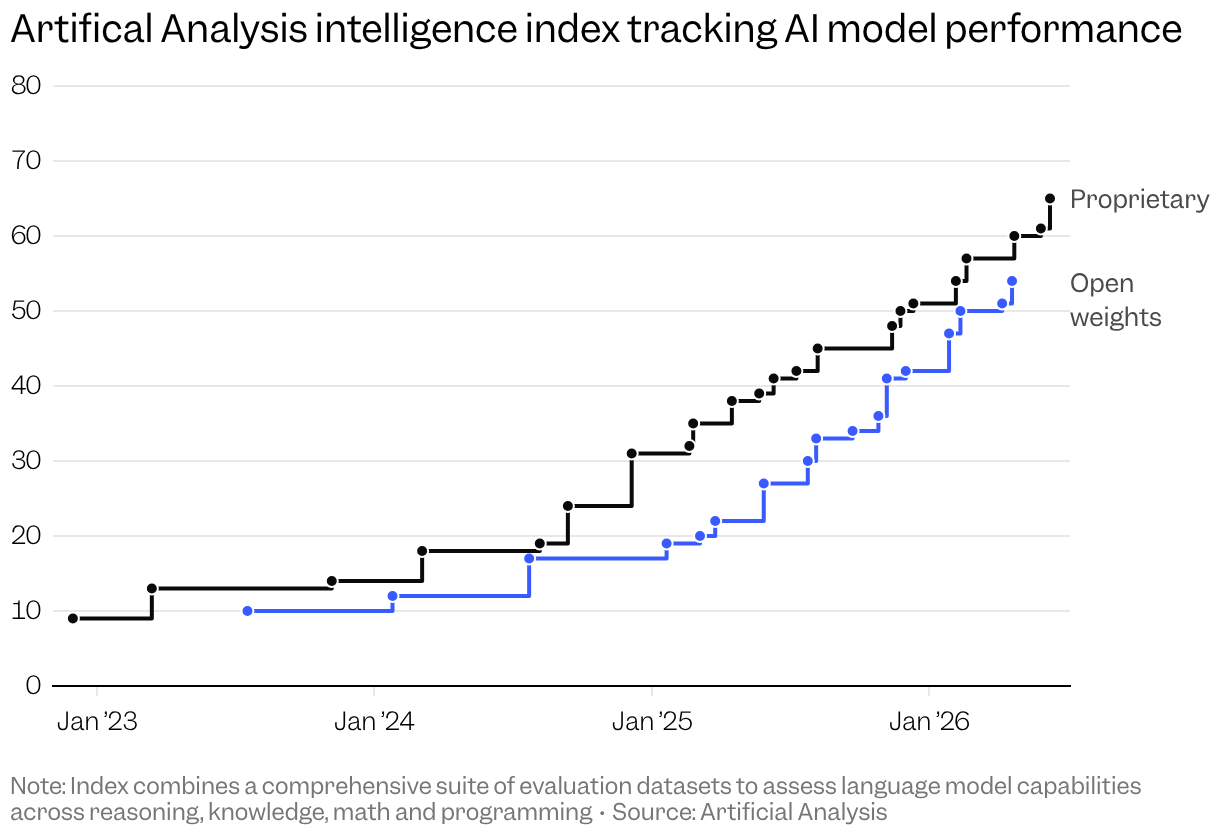
Arena's leaderboard shows similar pressure. On Thursday, Anthropic models were still at the top for expert text-based tasks such as math, coding, and creative writing. But Xiaomi's open-weight MiMo v 2.5 Pro wasn't far behind.
Arena
Then look at the price. That Xiaomi open model costs 43 cents per million tokens for inputs, and 87 cents per million for outputs. Anthropic's Fable 5 costs $10 per million input tokens and $50 per million output tokens — at least 20 times more expensive, according to Arena data.
"Almost as good" and "a lot cheaper" must be terrifying if you're spending billions to build frontier models. No wonder Anthropic is limiting rivals like this.
"This does read as a business move," said Nicholas Vincent, a computer science professor at Simon Fraser University, who studies how data is used in AI models. "Without much more explicit targeting of specific 'bad orgs,' it's pretty hard to defend how this could be more safety-focused than business-focused."
Anthropic does not owe rivals a shortcut to its best technology. But it should be honest about what's going on: Partly safety, but business, too.
Sign up for BI's Tech Memo newsletter here. Reach out to me via email at abarr@businessinsider.com.
Read the original article on Business Insider