Mounting API fees, bank outages, and a cross-border move almost crushed Trackfundx. Instead of giving up, co-founders Precious Arikeri and Wahab Balogun ditched open banking entirely to build a global AI tool that reads receipts instead. In this edition of Day 1 to 1000, OPEYEMI KAREEM charts how a lockdown spending problem evolved into a platform serving 10,000 users across 100 countries.
When COVID-19 lockdowns began in 2020, daily commutes stopped, social outings disappeared, and life moved indoors. Spending, in theory, should have dropped. For Precious Arikeri, the opposite happened. Between frequent online orders, data top-ups, and bank transfers, she found herself spending more than usual—with no easy way to track where the money was going.
“I was spending more than I would usually spend even while I was going to the office. I was ordering a lot, spending more on data because we were home, and buying a lot of things online, but I couldn’t track.”
She searched for an app to help, but available personal finance tools were poorly suited to how Nigerians manage money. Some required tedious manual entry; others were too rigid to adapt to her spending habits.
She brought the problem to Wahab Balogun, a software engineer she had worked with at IT firm Vascon Solutions, where she was a project manager. In June 2022, they launched their first attempt at a solution: a personal finance app that pulled transactions from multiple bank accounts into a single dashboard to help users track their spending and make better financial decisions.
Over the next two years, however, they learned that capturing a transaction is very different from understanding it—a realization that ultimately forced them to rethink the entire product.
Day 1: The first steps to making sense of money
In June 2022, Arikeri and Balogun launched Trackfundx. Built on the premise that people often hold money across several bank accounts without a consolidated view, Trackfundx enabled users to connect multiple accounts and view their aggregate spending.
The app was built on the idea that people often had money spread across different bank accounts, but no easy way to see their spending in one place. Trackfundx allowed users connect multiple bank accounts so they could pull their transactions into the app and get a clearer picture of their finances.
However, the first problem was that manually recording every transfer would not scale.
“If I have to come here and write, ‘transfer money for this, transfer money for that,’ it’s really not very efficient, and also time consuming,” Arikeri said.
She told TechCabal that most of her spending happened through her bank account (transfers or card payments), so the founders wanted Trackfundx to pull that data directly instead of making users record every expense themselves.
They pursued two paths simultaneously. They brought in a machine learning engineer to train an in-house categorisation model using volunteered bank statements, while Balogun integrated Mono—an open banking API—to fetch user bank transactions automatically.
They launched an early version using Mono as a free product to collect user feedback, later experimenting with weekly and monthly paid subscriptions.
As user activity grew, making transaction logs actionable proved difficult. A bank log indicated how much money left an account and when, but not what was actually purchased. When Mono launched its own categorisation feature, it still fell short of what Trackfundx needed.
“That category didn’t really work with us, because we also wanted to be able to customise ours. We wanted users to be able to customise theirs as well,” Arikeri said.
So they kept building their own machine learning categorisation system rather than relying on Mono’s, but this was only the beginning of the problems they would face with Trackfundx.
Day 500: The cracks started to show
The first issue was reliability. Trackfundx relied on open banking integrations, making the app’s stability dependent on banking infrastructure. In one instance, linking an account to Trackfundx repeatedly logged users out of their primary mobile banking app.
The second crack was cost. Mono had been charging roughly ₦200 per API call, meaning every time Trackfundx fetched a user’s transaction data, the cost added up.
“We just felt like we couldn’t build our business on another person’s business, because their pricing could change,” she said. “That was one of the business questions we started exploring”
Then, in September 2022, Arikeri moved to the UK for a master’s program, and ran into the third problem herself. TrackFunds was built around Nigerian bank accounts, so the app she had built to solve her problem stopped working the moment she needed it most.
“I may have changed my country, but I’m still particular about being able to track my finances, and I’m not able to do that here,” she said. She looked at what existed in the UK market and came up short again, the same gap she found in 2020, just in a different country.
By late 2023, the founders began exploring a major pivot. Balogun suggested incorporating generative AI. At the time, Arikeri was working in the UK insurance sector, where she saw AI document-extraction tools in action. She discussed these capabilities with Balogun, who was evaluating how AI could reshape their core product.
The core shift was simple: instead of parsing vague bank logs to infer purchases, let AI scan and read receipts directly. This approach eliminated Trackfundx’s primary bottleneck. A receipt-scanning tool did not depend on local banking APIs—it could work anywhere in the world.
Day 1000: Expense AI is born
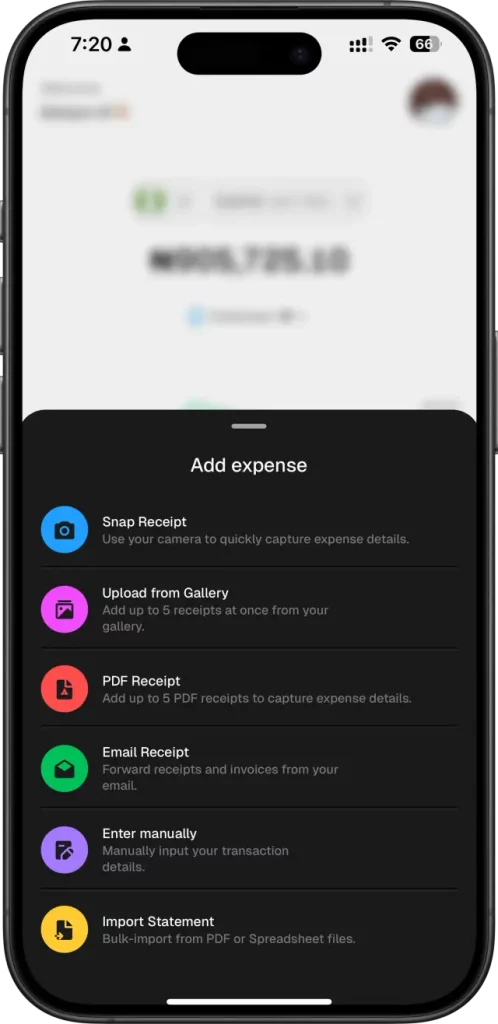
The receipt-reading experiment was different enough from Trackfundx that Arikeri and Balogun decided not to treat it as another feature of the old product. They rebuilt around it and created Expense AI in 2024.
Balogun handled the engineering while Arikeri took care of product, customer service, operations, and feedback. Expense AI remained deliberately small. For most of its life, it has been just the two founders.
With Expense AI, users could select a period and payment card and generate their expenses as a PDF or Excel report. The product also began moving beyond expenses. Trackfundx had allowed users to track income, create budgets, and set reminders, so the founders brought some of those capabilities back into Expense AI, including income and budgets, while adding savings tracking and personalised financial insights.
Today, the company says it has crossed 10,000 users across more than 100 countries, and has processed more than 80,000 expenses. Its subscriptions start at $8.99 monthly and are priced locally at ₦2,500 in Nigeria.
What started as one person’s inability to track her spending during a COVID-19 lockdown is now aimed higher.
“We see Expense AI for business,” Arikeri said, describing plans for a dedicated product for business owners where they could add multiple receipts. Beyond that, Arikeri said the company wants to cross a million users and $100,000 in annual revenue to make Expense AI the go-to finance app for people who want management apps.
True scale demands moving beyond surface-level integrations to robust execution. We’ve filtered the noise out of Moonshot 2026, optimising the conference strictly for high-calibre connections between startup founders, global financial operators, enterprise leaders and individuals rewiring Africa’s technical frameworks. Get 20% off Early Bird tickets for a limited time.
