Cet article est aussi disponible en français

First published 31 May, 2026
It is not every day you watch very smart people deliberately contradict themselves, but if you were at the 3i Africa Summit in Accra earlier this month, you might have seen it happen.
Premier Oiwoh is the chief executive officer of the Nigeria Inter-Bank Settlement System (NIBSS), Nigeria’s largest payment switch, which moves almost every naira between Nigerian banks. On the second day of the summit, which the Bank of Ghana convenes each year, he said something you rarely hear from someone in his position. He had grown tired, he said, of conferences like this one. They promise solutions that never arrive.
Panels at conferences are essentially formulaic in this sense: organisers put four or five decision-makers on stage, add a respected field moderator, and, for 30 or 40 minutes, work through a series of questions. Then the session ends, the room applauds, and little appears to change.
Oiwoh’s panel was about stitching African countries into a single financial bloc, modelled on how money moves across the European Union. Africans have tried and are still trying. PAPSS, the Pan-African Payment and Settlement System, already exists, but a borderless African payment rail still feels as distant as it did five years ago.
Yet Oiwoh still boarded a flight to Accra. He cleared space in a calendar most people would fight for. He travelled across the continent to attend another conference and another panel discussing a problem that remains unsolved.
Why? The answer has little to do with the stage, but who else is in the building.
Get smarter about Francophone Africa with our newsletter, Francophone Weekly—the startups, tech policies, and institutions building the pipelines for ecosystem growth.
SubscribeOiwoh did not travel to Accra for the panel. He came for the people the conference gathered in one place at one time. Other central bankers. Regulators from a dozen markets. Operators he might otherwise spend months trying to reach.
Olugbenga “GB” Agboola, who runs Flutterwave, arrived at a similar conclusion. We spoke shortly before lunch on one of the summit days, and he was direct about it. He attended with his chief legal officer and chief compliance officer because they could not afford to miss the opportunity to be in the same room as regulators from across the continent. For a payments company that depends on regulatory approval and partnerships in every market, that room matters more than any panel discussion.
It is also why I went to Accra. It was my second time at the summit and my first as a speaker. The opportunity to meet new sources, founders, regulators, and industry operators, and to share a bit about the work that I do, outweighed everything else.
For decision-makers like Oiwoh and GB, the chance to spend a few days with regulators, customers, partners, and peers is what makes the fifth or sixth conference worth attending.
What you should actually expect
If a conference is a product, we should be clear about what it contains, because it is not the same for everyone.
For a founder, the room holds capital and customers. Take Moonshot by TechCabal, for example. More than $5 billion in capital is represented by attending investors, and one in seven attendees is a funder, investor, or ecosystem enabler. A ten-minute conversation with a fund partner can achieve more than a cold email. Meeting a potential enterprise client can shorten a sales cycle by months.
For a regulator, the room holds the people they govern in a setting relaxed enough for formalities to fall away. A central banker can often learn more about where the market is heading from conversations with executives than from a stack of filings.
For companies like Flutterwave, a conference compresses months of travel into a few days. Instead of chasing regulators across multiple capitals, they can meet many of them under one roof.
For reporters, the room holds the one thing the job depends on: people willing to talk. A source met in person at a conference is more likely to answer your call six months later. A regulator who recognises your face is more likely to reply to your email.
Next Wave continues after this ad.
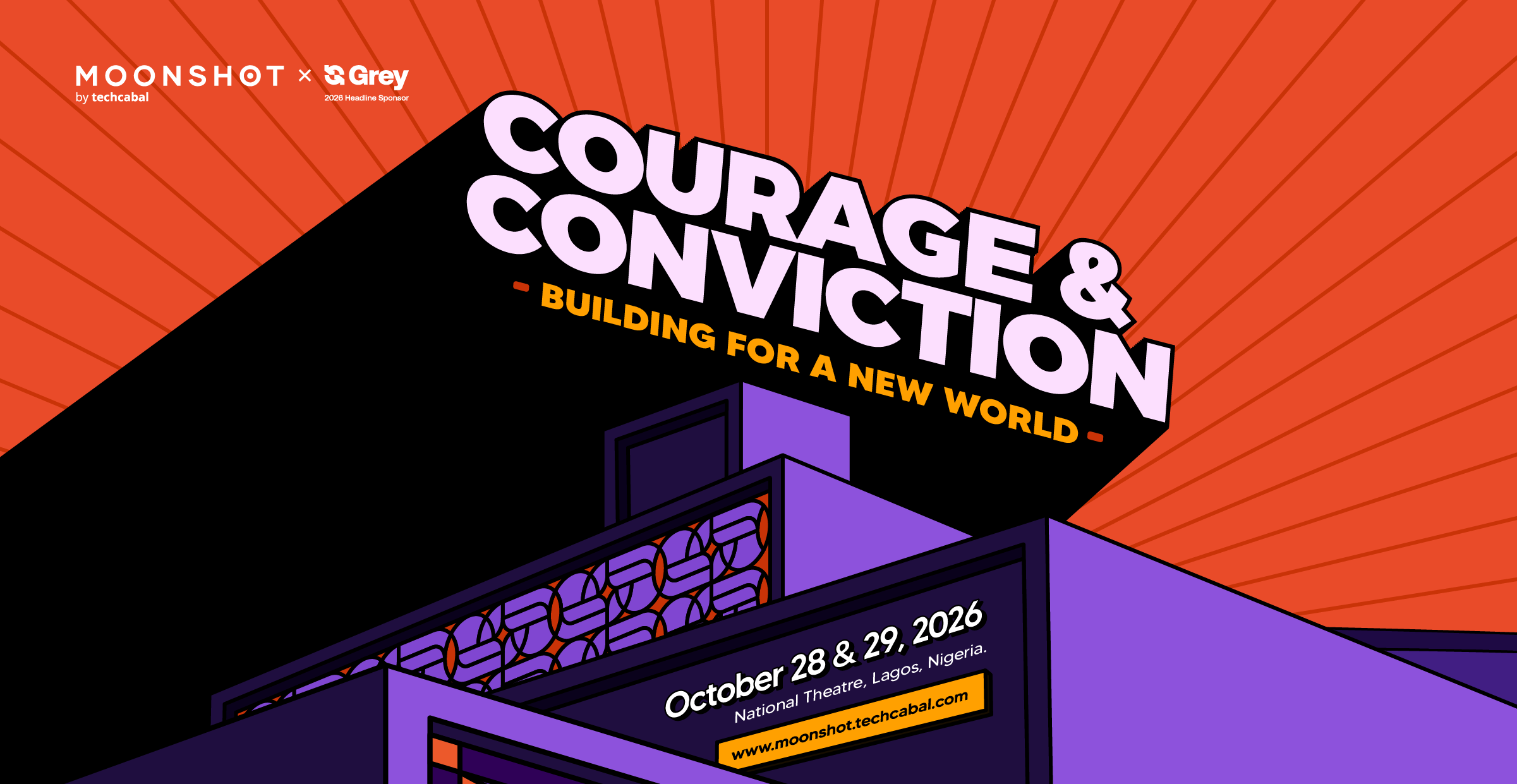
We’re thrilled to announce the official theme for Moonshot 2026: “Courage & Conviction: Building for a New World.”
This year, we’re calling on the African tech scene to back bold ideas and dig deep to build an ecosystem that solves African problems on a global scale.
The continent’s most ambitious founders, investors, LPs, operators, creatives, and policymakers will converge at Moonshot 2026 to chart Africa’s next era. You don’t want to be left out.
There is, of course, a limitation. The room is not open to everyone. The people who gain the most from these gatherings are often those who already possess capital, influence, or titles that secure invitations. Conferences can project inclusion through diverse panels and ambitious themes, while much of the practical value circulates among people who can afford the ticket, flight, and hotel bill.
That criticism is fair. But it is not the whole story.
Conferences also create opportunities for people outside the executive ranks. Of the more than 12,650 people who attended the last three Moonshot editions, most were not founders, investors, or chief executives. Many still found customers, collaborators, mentors, employers, employees, and new professional relationships.
Panels need to be re-worked
At this point, it helps to be honest about why the stage cannot deliver what many people expect (and this does not diminish the value of panels in any way.).
A panel is a performance, and everyone on it understands the limits. Nobody is going to solve Africa’s cross-border payment problem under stage lights. Nobody is going to make a concession that costs their organisation money while cameras are recording. Problems that have persisted for years cannot be resolved in forty minutes (but it helps to talk about them so that industry players are constantly reminded of what is at stake).
In my opinion, real decisions happen elsewhere; between two or three people speaking candidly over lunch; in corridors between sessions and in hotel bars late at night. Contacts are exchanged, meetings are scheduled, and trust begins to form. Sometimes the conversations that eventually lead to solutions start there.
Conferences do one job particularly well. They gather the right people in one city and give them a reason to clear their schedules.
What you should look for
Stop judging conferences by what gets decided on stage, because by that measure, most conferences fail, and Oiwoh is right to be frustrated. A panel built around prepared questions cannot solve long-standing industry problems. Judge conferences instead by the people they bring together. Conversations become possible that were impossible the week before. The right people leave with each other’s numbers and a reason to use them. That is the real product.
That has implications for both organisers and attendees. The hard work is curation, not programming. Panels matter, but the guest list matters more. Spend less energy polishing the agenda and more energy thinking about who is in the building and how easily they can find one another. At Moonshot, we take that idea a step further through a deal room, a dedicated space designed for private conversations that cannot happen on stage.
Attendees should approach conferences with the same mindset. Go in with clear expectations. Skip the occasional session, spend time in the corridor, the lunch queue, or the side rooms. Introduce yourself to people you do not know, ask (good) questions, conduct market research and hopefully, build relationships. The room is the point.
Muktar Oladunmade
Muktar Oladunmade is a Senior Reporter at TechCabal, where he covers African fintech, venture capital, and startups. He attended the 3i Africa Summit 2026 in Accra as a speaker.
Thank you for reading this far. Feel free to email muktar[at]bigcabal.com, with your thoughts about this edition of NextWave. Or just click reply to share your thoughts and feedback.
We’d love to hear from you
Psst! Down here!
Thanks for reading today’s Next Wave. Please share. Or subscribe if someone shared it to you here for free to get fresh perspectives on the progress of digital innovation in Africa every Sunday.
As always feel free to email a reply or response to this essay. I enjoy reading those emails a lot.
TC Daily newsletter is out daily (Mon – Fri) brief of all the technology and business stories you need to know. Get it in your inbox each weekday at 7 AM (WAT).
Follow TechCabal on Twitter, Instagram, Facebook, and LinkedIn to stay engaged in our real-time conversations on tech and innovation in Africa.
If you liked this edition of Next Wave, please share with your friends. And feel free to reply with thoughts and feedback. We welcome those.



18, Nnobi Street, Surulere, Lagos, Nigeria
View in Map You received this email because you signed up on our website or made purchase from us. If you know longer wish to recieve these emails, please unsubscribe