For most of human history, intelligence and labor were inseparable.
If you wanted work done, you needed people.
Whether it was writing reports, analyzing markets, managing logistics, answering customer questions, reviewing contracts, or building software, every productive system ultimately depended on human intelligence applied through human labor.
That assumption is beginning to break.
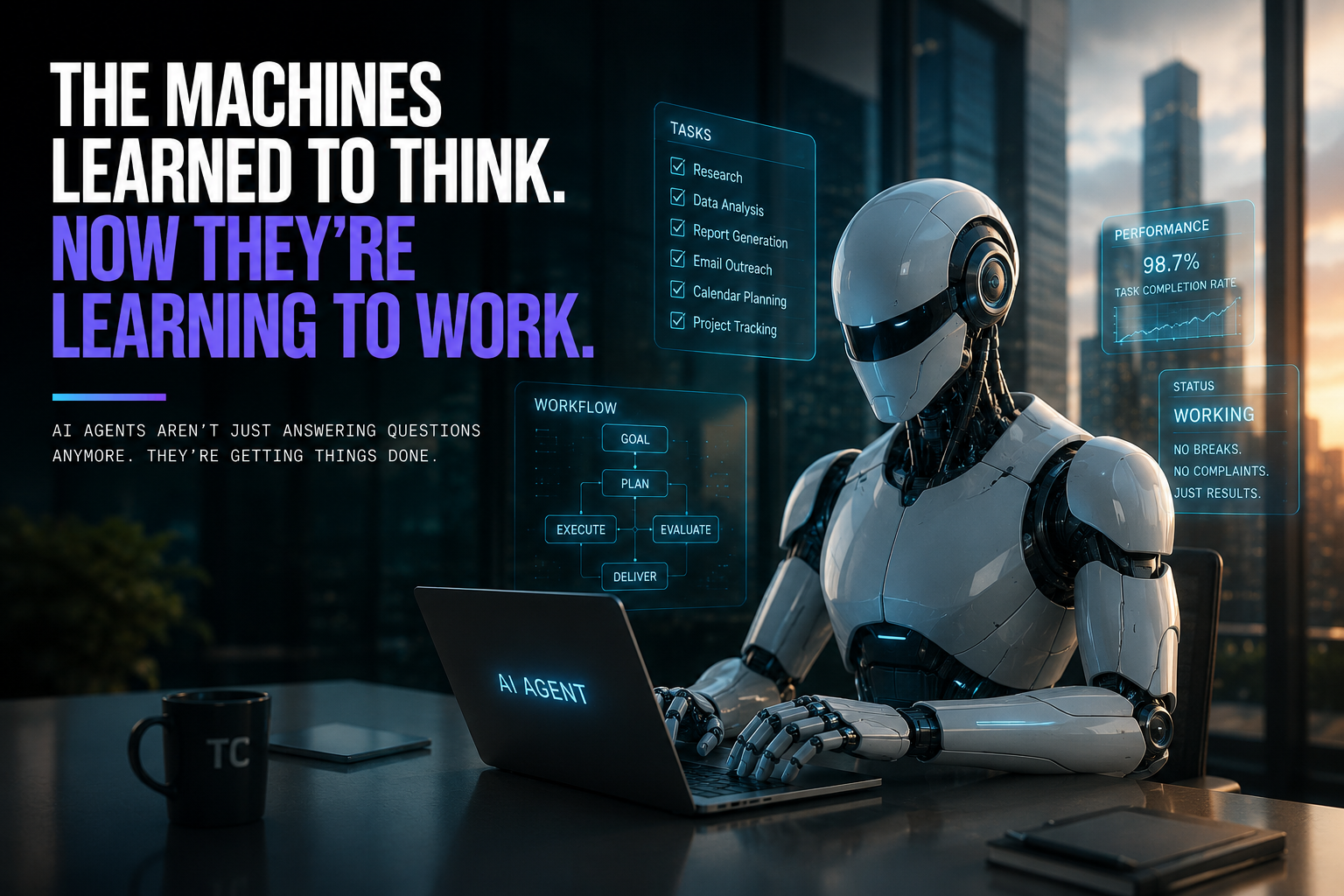
The first shock came when machines learned to think.
The second shock is happening now.
They're learning to work.
And unlike previous technological revolutions, this one isn't targeting muscle. It's targeting cognition.
The First AI Revolution Was About Information
When generative AI exploded into the mainstream, the focus was largely on knowledge.
AI could answer questions.
It could write essays.
It could summarize documents.
It could generate code.
It could create images.
For many people, these capabilities felt impressive but limited. AI was a tool. A powerful one, certainly, but still something waiting for human instructions.
The prevailing belief was that AI would make workers more productive.
Few expected it to become the worker.
But that's exactly what is beginning to happen.
The Rise of Digital Labor
A growing number of organizations are no longer using AI merely to assist employees.
They're using AI to perform tasks that previously required employees.
The difference is subtle but profound.
Traditional software helps humans do work.
AI agents do the work themselves.
Give a modern AI agent access to the internet, internal systems, databases, APIs, and business tools, and it can increasingly operate like a junior employee.
It can:
Research competitors
Analyze data
Draft reports
Manage calendars
Respond to customer inquiries
Generate marketing campaigns
Write software
Monitor systems
Produce documentation
And perhaps most importantly, it can work continuously.
No lunch breaks.
No sick days.
No vacations.
No complaints.
The economics are difficult to ignore.
From Tasks to Entire Workflows
Many people still think of AI in terms of individual tasks.
Writing an email.
Generating an image.
Creating a spreadsheet formula.
But the frontier has moved beyond tasks.
The new battleground is workflows.
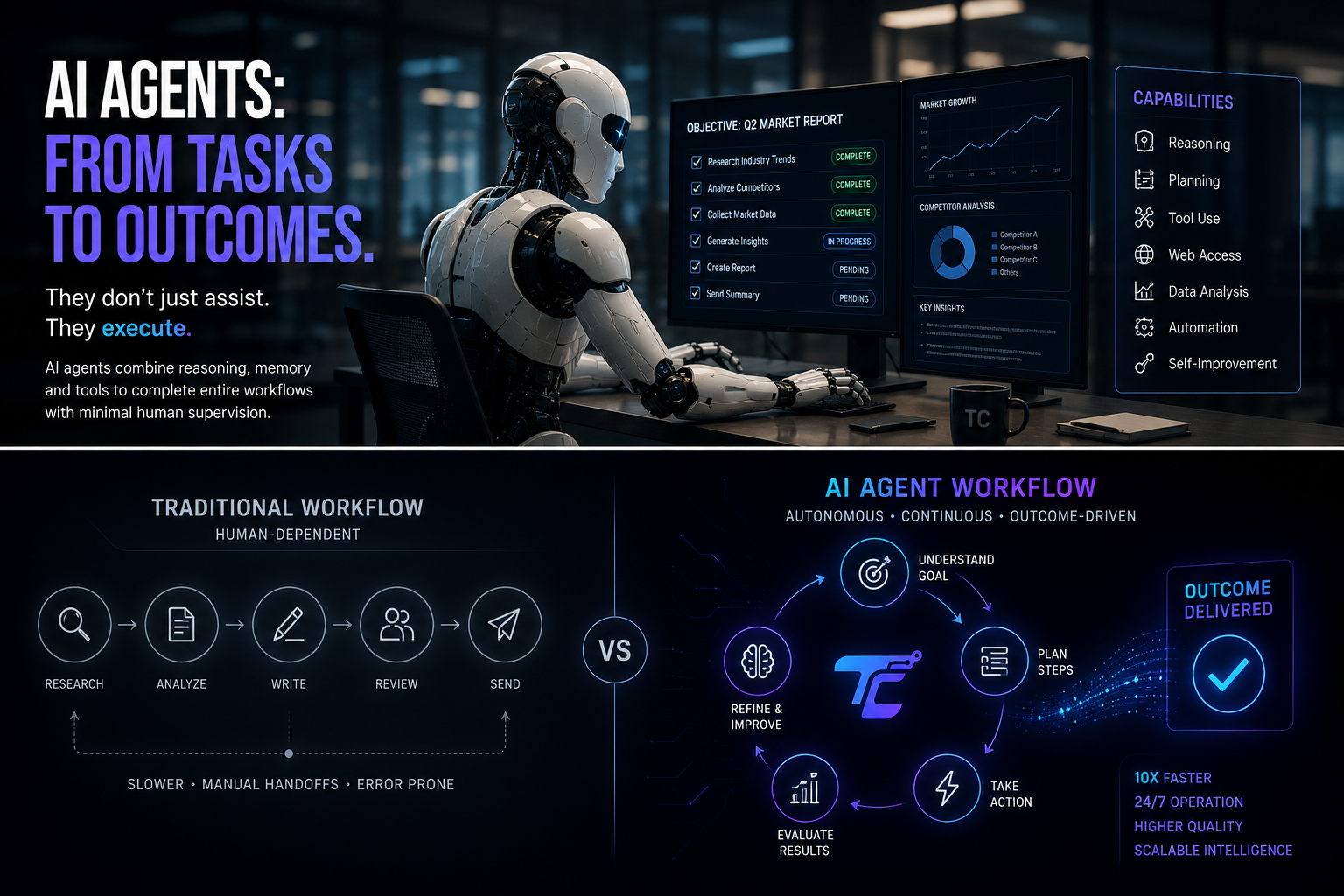
An AI agent doesn't just write an email.
It researches the recipient, drafts the message, personalizes the content, schedules delivery, tracks engagement, follows up automatically, and updates the CRM afterward.
The entire process becomes automated.
This is where the true disruption begins.
Because businesses don't buy technology to automate tasks.
They buy technology to automate outcomes.
The Birth of the Agent Economy
The most important trend in artificial intelligence today may not be larger models.
It may be the emergence of autonomous agents.
These systems combine reasoning, memory, planning, and tool usage to achieve objectives with minimal supervision.
Instead of asking AI a question, companies assign it a goal.
That distinction changes everything.
A goal like:
"Monitor competitor pricing and alert me to significant changes."
Or:
"Research the market, generate a report, and prepare a presentation for Monday's meeting."
Or:
"Identify support tickets at risk of escalation and resolve them automatically."
These are no longer science-fiction scenarios.
They are rapidly becoming standard operating procedures.
An entirely new digital workforce is beginning to emerge.
The Workforce Nobody Hired
The most disruptive aspect of AI agents is that they don't appear on payroll.
Companies can deploy hundreds or even thousands of agents without recruiting, onboarding, or managing a traditional workforce.
The result is a new category of labor.
Not human labor.
Not physical labor.
Digital labor.
And unlike previous forms of automation, digital labor can perform cognitive work.
For decades, knowledge workers believed their jobs were insulated from automation.
Machines could replace factory workers.
Machines could replace cashiers.
Machines could replace drivers.
But creative thinking, analysis, decision-making, and communication were supposed to remain uniquely human.
That assumption is now being tested.
The Great Productivity Explosion
History suggests that every major technological revolution creates more productivity than society initially imagines.
Electricity transformed factories.
Computers transformed offices.
The internet transformed communication.
Artificial intelligence may transform every industry simultaneously.
Organizations deploying AI agents are reporting dramatic reductions in time spent on repetitive processes.
Tasks that once required days can often be completed in hours.
Processes that required teams can increasingly be managed by individuals supported by intelligent systems.
The implications extend beyond cost savings.
Entire business models become possible when labor scales at near-zero marginal cost.
That may be the defining economic story of the next decade.
What This Means for Africa
While much of the discussion around AI focuses on job displacement, emerging markets may experience a different reality.
Across Africa, many businesses operate with constrained resources, limited access to specialized talent, and lean operational teams.
AI agents could become force multipliers.
A startup in Lagos can operate with capabilities that previously required a much larger workforce.
A logistics company in Nairobi can automate reporting and operational monitoring.
A media platform can generate intelligence products at a scale that would have been impossible just a few years ago.
A healthcare organization can automate administrative workflows and free human professionals to focus on patient care.
For many organizations, AI is not replacing existing capacity.
It is creating capacity.
That distinction could prove transformative.
The Governance Challenge
Yet amid the excitement lies a difficult question.
What happens when an AI system makes a costly mistake?
Who is responsible?
Who is accountable?
Who audits the decisions?
The technology is advancing far faster than the frameworks designed to govern it.
Companies are increasingly deploying autonomous systems into environments where legal, ethical, and operational standards remain unclear.
The consequences of that gap are likely to become one of the defining policy debates of the AI era.
The New Operating System for Work
For years, artificial intelligence was viewed as a tool for thinking.
Now it is becoming a system for working.
The distinction may seem small.
It isn't.
When machines learn to think, information changes.
When machines learn to work, economies change.
Organizations change.
Industries change.
And eventually, society changes.
The question is no longer whether AI will become part of the workforce.
It already has.
The question is how quickly the rest of the world adapts.
Because while most people are still debating what AI can do, the machines have already started doing the work.