

TGIF. 
Moonshot 2026 flash sale: Get 30% off your ticket
The conversation that changes your career, introduces you to your next investor, or opens a new market might be one you almost skipped. At Moonshot 2026, two days bring you closer to the founders, investors, operators, and builders shaping what African business and technology does next. On October 28–29, the National Theatre in Lagos becomes the meeting point for the people building Africa’s future.
If Moonshot has been on your list, now is the time to commit. Get 30% off all tickets during the flash sale, from October 16 to 24.

Read smart insights about Francophone Africa’s tech ecosystem—weekly.
Subscribe
- IPO fever for MNT-Halan
- Ethiopia keys into PAPSS’s vision
- South Africa is rethinking AI policy
- Who secured the bag?

💰 - World Wide Web 3
- Job Openings
Companies
MNT-Halan’s IPO is pulling money out of Egypt’s stock market
The initial public offering (IPO) everyone wants is creating an awkward problem: investors need cash to buy it, so some are selling the stocks they already own. And we can’t even tell if that’s a good or bad headache to have.
Egyptian fintech unicorn MNT-Halan’s retail offer was 13.5 times oversubscribed going into its final session on Thursday. Orders worth EGP 15.9 billion ($304 million) chased just EGP 1.18 billion ($22.5 million) worth of shares, according to local publication EnterpriseAM. Its institutional offer had already closed 11.2 times oversubscribed.
Explain like I’m new here: MNT-Halan is selling 320 million existing shares, about 20% of its Egyptian business, at EGP 24.50 ($0.47) each. The offer should raise about EGP 7.84 billion ($150 million) for shareholder MNT Investments B.V. Trading begins on October 20.
But Egypt’s stock market has been feeling the side effects. The exchange lost roughly EGP 204 billion ($3.9 billion) in market value over three sessions through Tuesday. Smaller stocks were hardest hit, with the EGX70 falling about 9%, compared with 3.8% for the blue-chip EGX30.
Between the lines: Some fund managers are selling shares to free up cash for MNT-Halan and the IPOs coming behind it, including Banque du Caire. When enough investors do that at once, existing stocks have fewer buyers. Prices fall, and investors who bought the shares with loans can be forced to sell too.
MNT-Halan’s early success tells us something paradoxical: there is strong demand for new Egyptian listings, but the market does not have unlimited cash to absorb them.
What to watch: MNT-Halan begins trading next Tuesday, one of Egypt’s most-anticipated IPOs. A strong debut could encourage investors to keep making room for the much larger Banque du Caire IPO, the country’s sixth-largest commercial bank listing in November. But a weak one could make them less eager to sell existing holdings for the next deal.



Your success and ours are the same story. Happy Customer Service Week. This year’s theme is The Extra Mile, and it’s the only way we know how to do this. Visit: fincra.com.
payments
Ethiopia joins Africa’s cross-border payment network

Say an Ethiopian business wants to pay a supplier in Nigeria. The money can pass through several correspondent banks, collecting fees and delays along the way. Africa built a system to shorten that journey. Now, its push for a continent-wide payment network has added another piece to the puzzle.
What happened? The National Bank of Ethiopia (NBE), the country’s central bank, has joined the Pan-African Payment and Settlement System (PAPSS). Ethiopian banks and licenced payment companies can now use PAPSS to send cross-border payments to financial institutions in other participating African markets.
Explain like I’m new here: In January 2022, the African Export-Import Bank (Afreximbank), the African Union, and the African Continental Free Trade Area (AfCFTA) Secretariat launched PAPSS.
It handles the payment between participating banks and fintechs, while central banks provide the framework for settling transactions in local currencies. Instead of an Ethiopian business paying a Nigerian supplier through a chain of banks outside the continent, the payment can move through an African network.
Why Ethiopia matters: Ethiopia already trades with the rest of Africa, but there is plenty of room for that trade to grow. In 2023, the country’s intra-African trade was about $2.48 billion, just 12.64% of its total trade. At 12.64%, payments are clearly not the only thing holding that trade back. But removing one more layer of cost and delay gives Ethiopian businesses fewer reasons to avoid African suppliers.
How big is this thing now? PAPSS has also expanded beyond the payment rail. Through the African Currency Marketplace, PAPSS lets businesses and financial institutions exchange participating African currencies, while PAPSSCard, its local card network, lets businesses make payments within the continent. PAPSS said it connects 30 African countries, 24 central banks, about 200 financial institutions and more than 16 payment switches—all spanning Nigeria, Ghana, Kenya, Tanzania, Uganda, and Zambia.
However, joining the network is only the beginning. Banks and fintechs still have to connect their systems and make PAPSS available to customers.
If you log in to apps such as Fidelity Bank, mild ads are laced across your screen, asking you to make payments to Kenya or Ghana. If PAPSS achieves its seemingly difficult goal of fixing intra-African payments, merchants may no longer need to handle dollars.

True scale demands moving beyond surface-level integrations to robust execution. We’ve filtered the noise out of Moonshot 2026, optimising the conference strictly for high-calibre connections between startup founders, global financial operators, enterprise leaders and individuals rewiring Africa’s technical frameworks. Join us on October 28 & 29, 2026. Get your ticket.
regulation
South Africa is restarting its AI policy after an awkward first attempt

South Africa wanted to write the rules for an AI-powered future, but its first attempt got caught hallucinating. Five months after fabricated academic references forced the government to pull its draft AI policy, the country is trying again. Communications minister Solly Malatsi has confirmed that the government is still pushing ahead with a replacement AI policy, after an embarrassing detour.
Explain like I’m new here: In April, the Department of Communications and Digital Technologies (DCDT) withdrew its draft national AI policy after an internal review confirmed that its reference list contained fictitious sources. The Cabinet approved the document in March, and it was published for public comment. The government suspended two officials for failing to disclose AI use in preparing the material. One has since resigned, while disciplinary proceedings against the other are still ongoing.
What’s different this time? Malatsi said the department has tightened accountability around the process, while an independent panel led by Professor Benjamin Rosman is now working on the replacement policy. The policy is expected to go to Cabinet by the end of March 2027, with public consultation expected to begin in April. After the first draft hallucinated its references, the next draft will likely face much closer scrutiny before it reaches the Cabinet or the public.
insights
Funding Tracker
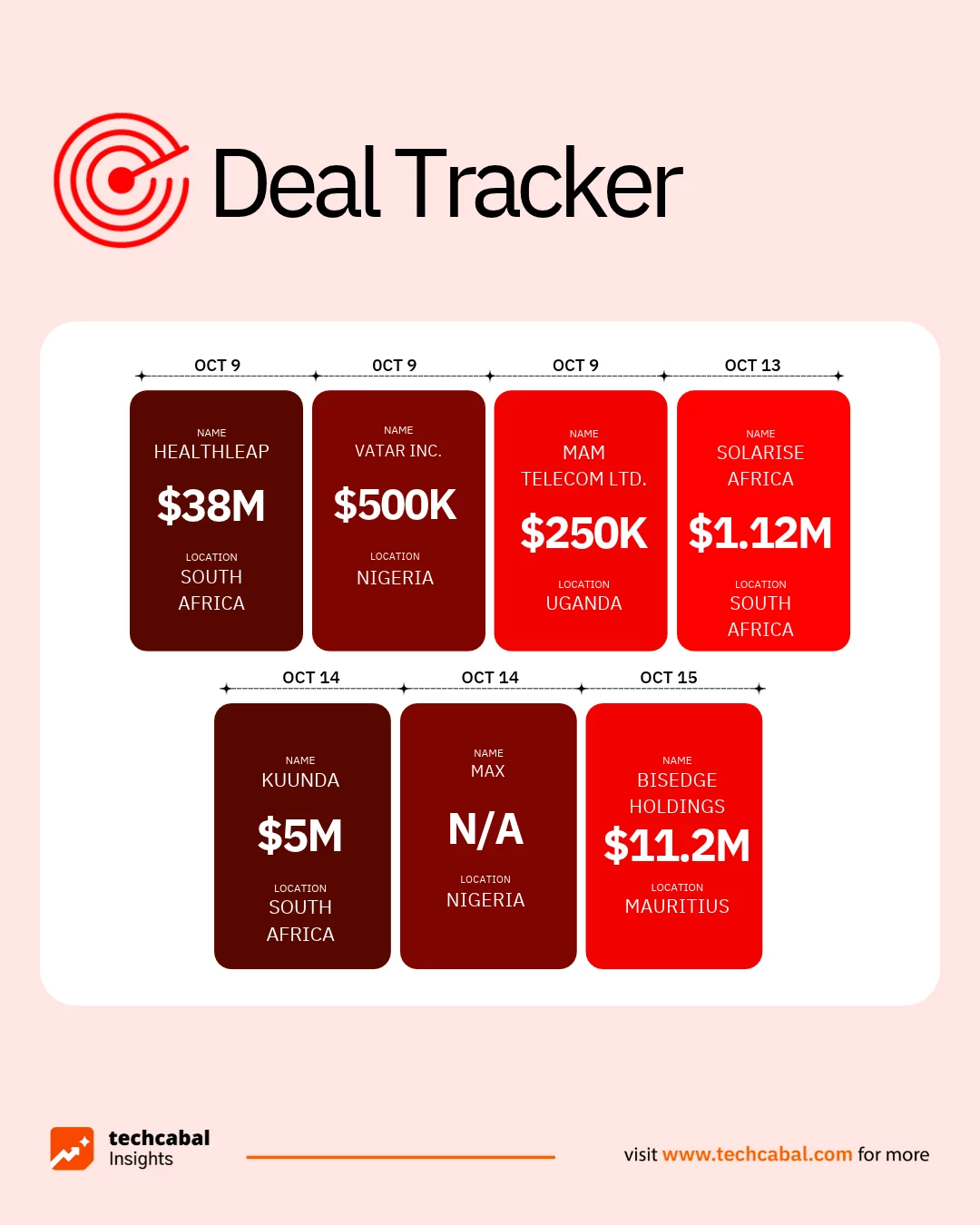
Healthleap, a South African healthtech startup, raised $38 million in a combined Seed and Series A round from Sequoia Capital, First Round Capital, and Hummingbird Ventures. (Oct 9)
Here are the other deals for the week:
- Vatar Inc., a Nigerian gaming startup, raised $500,000 in an angel round led by Resilience17, with participation from the CEO of Terra Industries and the CEO of Mono. (Oct 9)
- MAM Telecom Ltd., a Ugandan fintech startup, raised a $250,000 grant from an anonymous South African businessman. (Oct 9)
- Solarise Africa, a South African climate tech startup, secured a $1.12 million grant from the Energy and Environment Partnership Trust Fund (EEP Africa). (Oct 13)
- Kuunda, a South African fintech startup, raised $5 million in funding led by E4E Africa with participation from Accion Ventures, Portugal Gateway Fund, and Seedstars Africa Ventures. (Oct 14)
- MAX, a Nigerian e-mobility startup, secured an undisclosed investment from Nithio. (Oct 14)
- Bisedge Holdings, a Mauritian logistics company, secured an $11.2 million senior debt facility from Finnfund. (Oct 15)
That’s all for this week. Before you go, African startups have spent the past decade raising billions. But how much of that investment has actually made its way back to investors? Find out what the numbers reveal here.
Follow us on Twitter, Instagram, and LinkedIn for more funding announcements.
CRYPTO TRACKER
The World Wide Web3
Source:

Coin Name
Current Value
Day
Month

+ 1.94%
+ 8.23%
+ 4.12%
+ 1.79%
+ 3.17%
+ 3.33%
+ 4.13%
+ 9.07%
* Data as of 06.54 AM WAT, October 16, 2026.
JOB OPENINGS
- Bumpa — Social Media Associate — Lagos, Nigeria
- Paystack — Product Manager, Financial Systems, several other roles — Hybrid (Lagos, Nigeria)
- Paystack — Product Manager, South Africa, Account Manager — Hybrid (Cape Town, South Africa)
- Paystack — Platform Security Engineer — Nigeria, Kenya, South Africa
- Qore — Engineering Specialist, Offensive Security — Lagos, Nigeria
- OPay — PR Strategist — Lagos, Nigeria
- RadioNow — Videographer — Lagos, Nigeria
Looking for more opportunities? There are additional openings on TechCabal’s job board. We’ve also cleared out outdated listings to keep opportunities fresh for job seekers. If you’re hiring and would like to feature an open role, please submit it via this form.

- Kaspersky’s African business is profitable. Now it wants bigger clients.
- Moniepoint UK made $36,284 after taking on MonieWorld customers
- African startups raise $2.49B in 9 months as Q3 rebounds
Written by: Success Sotonwa, Emmanuel Nwosu and Yemi Kareem
Edited by: Emmanuel Nwosu & Ganiu Oloruntade
Want more of TechCabal?Sign up for our insightful newsletters on the business and economy of tech in Africa.
- The Next Wave: futuristic analysis of the business of tech in Africa.
- Francophone Weekly by TechCabal: insider insights and analysis of Francophone’s tech ecosystem
P:S If you’re often missing TC Daily in your inbox, check your Promotions folder and move any edition of TC Daily from “Promotions” to your “Main” or “Primary” folder and TC Daily will always come to you.