The Bank of Central African States (BEAC) has joined the Pan-African Payment and Settlement System (PAPSS), bringing six CEMAC countries into the network and expanding intra-African payment capabilities.
Intelligence Insights
Context + impact, normalized for TechCulture.
The Big Picture
The Bank of Central African States (BEAC) has joined PAPSS, Africa's continental payments network, adding all six CEMAC countries—Cameroon, Gabon, Republic of Congo, Central African Republic, Equatorial Guinea, and Chad—at once. PAPSS now connects 28 African countries, over 190 commercial banks and fintechs, and 16 payment switches, enabling direct local currency settlements instead of routing through correspondent banks abroad. This move is significant because BEAC represents a regional central bank with a shared currency, allowing a single signature to bring multiple countries into the network. Later this year, PAPSS plans to pilot a direct payment corridor between BEAC and BCEAO, linking West and Central Africa for the first time. Cross-border payments remain a major barrier to intra-African trade, and PAPSS has already reduced transaction costs by up to 27% in participating markets, making this expansion a key step toward continental financial integration.
Why It Matters
The Central African bank's entry into PAPSS is a major step toward reducing Africa's reliance on foreign currencies and correspondent banks for intra-continental trade. By enabling direct local-currency settlements across 28 countries, the network could significantly lower transaction costs and accelerate cross-border commerce, making it easier for businesses and individuals to move money within Africa.
Afrinvest, VFD, PiggyVest, and Bumpa have one thing in common: they’re all hiring this week. If you’re looking for opportunities in African tech and beyond, visit our job board to find roles that match your skills and career goals.
Get smarter about Francophone Africa with our newsletter, Francophone Weekly—the startups, tech policies, and institutions building the pipelines for ecosystem growth.
Opeyemi Folorunsho (centre), Vice President of Research and Development, Moniepoint
Opeyemi Folorunsho is the Vice President of Research and Development (R&D) at Moniepoint, where he focuses on translating deep technical ideas into systems that deliver real-world impact. His background is in distributed systems and infrastructure, and his work sits at the intersection of research and execution: identifying emerging opportunities, rigorously validating them, and building the platforms that bring them to life.
Explain your job to a five-year-old.
Imagine you have a huge toy city where millions of people are playing every day. My job is to invent better roads, stronger bridges, and smarter traffic lights before the city gets too busy.
Sometimes I build new things myself. Sometimes I help other engineers build them. And sometimes I spend weeks figuring out a better way to solve a problem that nobody has solved before. My job is really to make sure the city keeps working even when millions more people arrive.
What does R&D at a fintech actually look like day-to-day?
A typical week involves understanding a difficult business problem, reading papers or technical documentation, evaluating existing technologies, building prototypes, measuring trade-offs, and deciding whether an idea deserves to become part of the production platform.
How do you decide when an idea is ready to become a product?
I look for three things. First, have we actually solved the hard technical problems, or have we only built a good demo? Second, does the solution reduce complexity instead of adding it? A prototype can tolerate cleverness. A production system cannot. Third, does it solve a real problem that multiple teams have? If only one engineer understands it or only one team benefits from it, it’s probably still research.
Moniepoint has scaled aggressively across Africa. What does that kind of growth demand from an infrastructure standpoint?
At Moniepoint, operating at scale means designing systems that can handle billions of financial events, maintain low latency, recover gracefully from failures, and continue operating across different regions and varying network conditions. It also means investing heavily in internal platforms. As an engineering organisation grows, developer productivity becomes an infrastructure problem too.
What did your path to VP of R&D look like, and what would you do differently if you were starting over?
As I moved into leadership, I realised that R&D isn’t just about technology. It’s about creating a process that turns uncertainty into informed decisions. Today, a large part of my role is helping the organization explore new ideas while ensuring the successful ones can be handed over to product teams and scaled across the business.
If I were starting over, I would spend less time chasing individual technologies and more time learning systems thinking, communication, and economics. Languages, frameworks, and databases come and go.
Modern Rails for Africa’s Economy: How Fincra is helping businesses collect, pay out, convert, and settle across African markets. Read more here.
connectivity
Ghana is reopening the race to bring 5G to the country
Image Source: Tenor
Imagine telling the fastest runners to wait on the sidelines because only one contender is allowed on the track. That’s basically what Ghana tried to do with its 5G rollout. But the plot twist it didn’t expect is that the race isn’t moving fast enough. Now, it’s inviting everyone back on the track.
What happened? Ghana is preparing to sell 5G licences to mobile operators, with MTN Ghana, a subsidiary of Africa’s largest telecom, and Telecel, another operator, already saying they’re ready to bid.
The lore behind the ‘only one contender’: In 2024, Ghana handed Next-Gen InfraCo (NGIC), the state-backed network provider, exclusive rights to provide Ghanaians with access to the 5G network for the next decade.
The country wanted to build its 5G economy around one sole operator, NGIC, where it has a vested interest, and which would build the network while telecom companies leased capacity instead of deploying their own infrastructure.
Expectation versus reality: With the new plan to open up the taps for 5G licences to flow to other telecoms, Ghana is gearing up for more competition. More 5G licence holders should mean more networks, better coverage, and, eventually, lower prices.
Zoom out: The NGIC currently has about 49 operational 5G sites, far lower than the government’s target of 1,200 by 2027. If Ghana wants to accelerate 5G adoption in its backyard, it needs to play a team sport—and it appears it has accepted this reality.
Naira Life 2026 is here!
The theme for this year’s Naira Life Conference by Zikoko is “All About Wealth.” Join 2,000+ in Lagos on August 22 for a day of practical money conversations and workshops designed to move you from simply earning an income to building lasting wealth. Get 15% off early bird tickets.
banking
Central Africa just joined PAPSS, Africa’s continental payments network
Image Source: Tenor
If you check your bank app today, you might notice that you’re now able to send money to other African countries like Ghana or Kenya, depending on the bank you use. Fidelity Bank, a Nigerian mid-tier lender, for example, has been pushing this feature every time I open its app.
The technology making intra-African payments possible at this scale has just expanded again, bringing another part of Africa into the fold.
Explain like I’m new here: The Pan-African Payment and Settlement System (PAPSS) is Africa’s attempt to stop African money from taking a holiday overseas before reaching another African country. Instead of routing payments through correspondent banks in New York, London, or Paris and converting into dollars or euros along the way, PAPSS lets banks settle cross-border payments directly in local currencies. It launched in 2022 and has been expanding steadily ever since.
What’s happened? The Bank of Central African States (BEAC) has joined PAPSS, bringing all six countries in the Central African Economic and Monetary Community (CEMAC)—Cameroon, Gabon, the Republic of Congo, the Central African Republic, Equatorial Guinea, and Chad—into the network at once. PAPSS said it now connects 28 African countries, more than 190 commercial banks and fintechs, and 16 payment switches.
Why this matters: BEAC’s accession is different because it represents a regional central bank with a shared currency and monetary system. One signature brings six countries into the network simultaneously. Later this year, PAPSS also plans to begin a pilot connecting BEAC with BCEAO, the West African central bank serving eight countries, creating the first direct payment corridor between West and Central Africa.
Zoom out: Cross-border payments remain one of the biggest barriers to doing business within Africa. PAPSS says it has already reduced transaction costs by as much as 27% in participating markets. With Central Africa now connected, the network is starting to look less like a collection of national payment systems and more like the continental financial infrastructure it was always meant to become.
Showcase Your Brand at Moonshot by TechCabal
Founders. Investors. Policymakers. Enterprise leaders. Moonshot 2026 brings together the people shaping Africa’s technology ecosystem across AI, commerce, climate, enterprise, and culture. Spotlight your brand today.
insights
Funding tracker
Image Source: TechCabal Insights
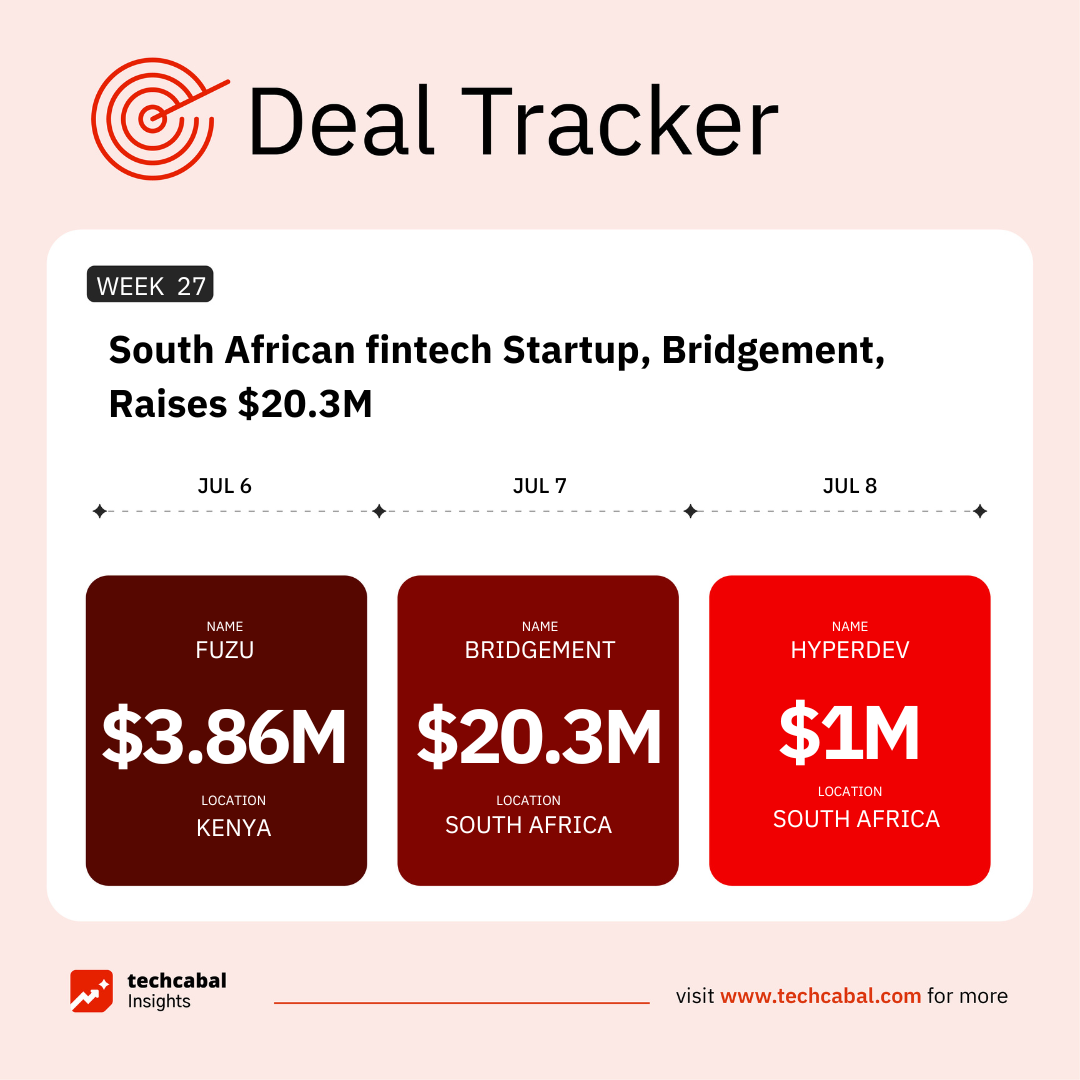
Bridgement, a South African fintech startup, raised $20.3 million in funding from Rand Merchant Bank (RMB) and Standard Bank. (Jul 7)
Here are the other deals for the week:
Fuzu, a Kenyan HRtech startup, raised $3.86 million in a Series A funding round from Sparkmind.vc, Finnfund, Cornerstone Enterprises, Aucfan Incubate, Seedstars International, Kepple Africa Ventures, Barona, and a group of angel investors. (Jul 6)
HyperDev, a South African AI startup, raised $1 million in seed funding from venture capital investors from Europe and the UK. (Jul 8)
Looking for more opportunities? There are additional openings on TechCabal’s job board. We’ve also cleared out outdated listings to keep opportunities fresh for job seekers. If you’re hiring and would like to feature an open role, please submit it via this form.
P:S If you’re often missing TC Daily in your inbox, check your Promotions folder and move any edition of TC Daily from “Promotions” to your “Main” or “Primary” folder and TC Daily will always come to you.