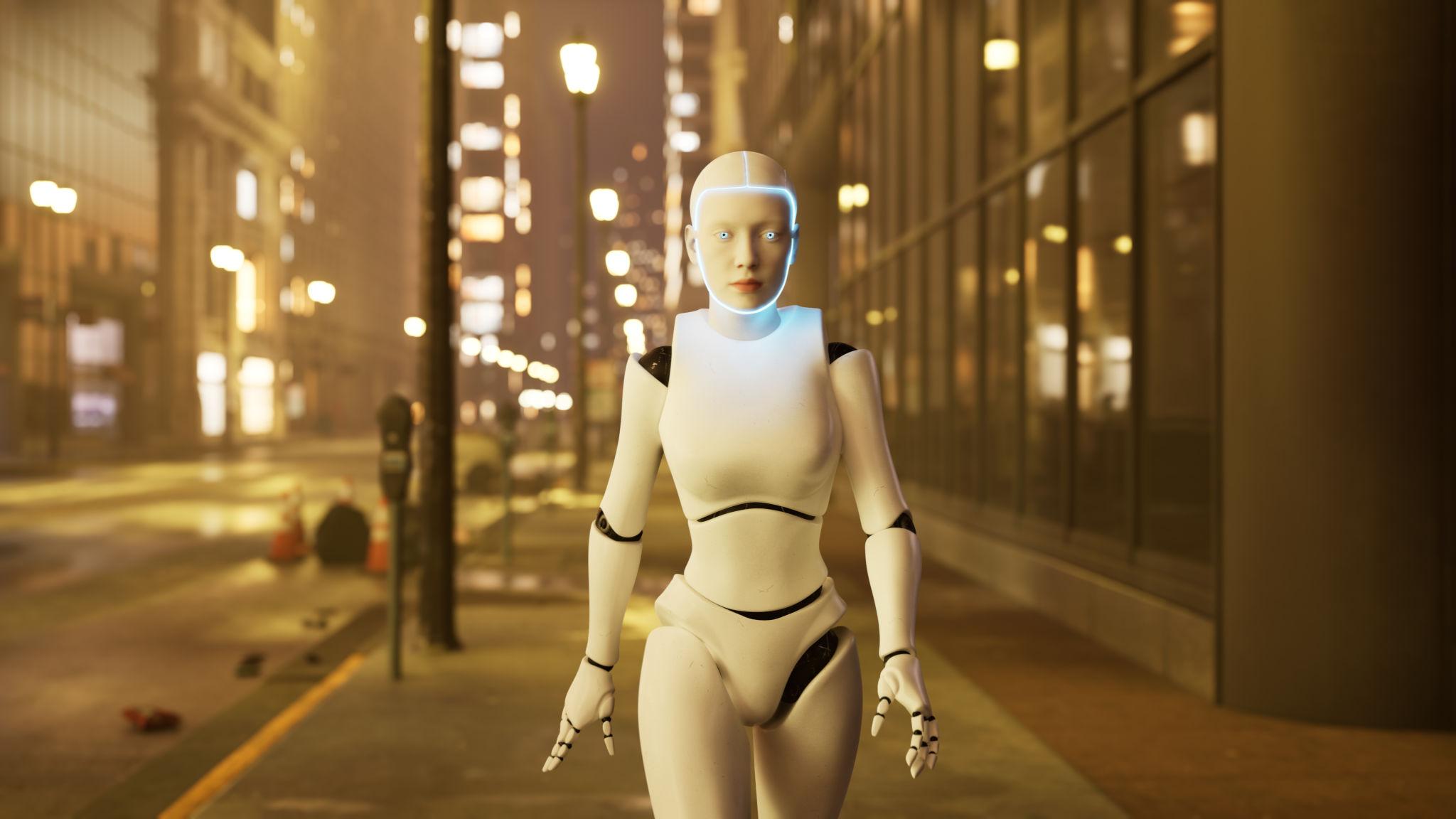
For decades, robots belonged to science fiction.
They were either clunky industrial arms bolted to factory floors or cinematic fantasies designed to entertain us with visions of the future. Real life felt very far away from the worlds imagined in films like I, Robot, Ex Machina, or Blade Runner.
Then something changed.
Quietly, almost without public consensus, robots stopped being experimental machines and started becoming intelligent physical systems capable of operating in the real world.
In 2026, humanoid robots are no longer confined to research labs and carefully controlled demos. They are walking through warehouses, assisting workers, carrying inventory, interpreting instructions, and learning tasks in real time.
And for the first time, this no longer feels like a future industry.
It feels inevitable.
Welcome to the era of Physical AI.
The Moment AI Escapes the Screen
The first AI revolution happened on screens.
Large language models transformed software into something conversational. Suddenly machines could write, reason, summarise, generate images, and interact with humans in ways that felt startlingly intelligent.
But that was only phase one.
Physical AI — also known as Embodied AI — is what happens when those same AI systems are given bodies.
Not virtual assistants.
Not chat interfaces.
Bodies.
Arms that can lift objects.
Legs that can navigate environments.
Eyes that can interpret space.
Hands that can manipulate fragile tools.
Brains that can adapt in real time.
This is the transition from digital intelligence to operational intelligence.
And it changes everything.
Because intelligence becomes exponentially more disruptive when it can physically act on the world around it.
Humanoid Robots Are Finally Becoming Useful
For years, humanoid robotics was trapped in what engineers call the “demo problem.”
Robots could dance.
Robots could wave.
Robots could backflip.
But they couldn’t do useful work consistently in unpredictable environments.
Real-world environments are messy.
Objects move.
Humans improvise.
Lighting changes.
Floors shift.
Unexpected situations happen constantly.
Traditional robots struggled outside tightly controlled factory systems because they relied on rigid programming. Every action needed predefined instructions.
That model is collapsing.
Thanks to breakthroughs in AI reasoning, computer vision, reinforcement learning, and spatial intelligence, robots are becoming adaptable instead of scripted.
Modern humanoid systems can now:
interpret spoken language
understand context
navigate unfamiliar environments
manipulate objects dynamically
recover from mistakes
learn from observation
That leap is enormous.
It means robots are evolving from machines that perform single tasks into machines capable of general-purpose labour.
And some of the world’s biggest technology companies are betting heavily on it.
The New Robotics Arms Race
A global robotics race is now underway.
Companies like Figure AI, Boston Dynamics, Tesla, and Agility Robotics are pushing aggressively toward commercial deployment.
The goal is no longer building impressive prototypes.
The goal is building autonomous labour.
That distinction matters.
Because once humanoid robots become economically viable workers, entire industries begin to change shape.
Warehousing changes.
Manufacturing changes.
Logistics changes.
Healthcare changes.
Retail changes.
Agriculture changes.
Eventually, almost every sector involving repetitive physical work changes too.
And unlike previous generations of industrial machines, humanoid robots are designed to fit into spaces built for humans.
That means companies won’t need to redesign entire infrastructures around robotics.
The robots are being designed around us.
The Real Breakthrough Isn’t Hardware — It’s Intelligence
Most people assume the revolution is about robotics hardware.
It isn’t.
The true breakthrough is AI cognition.
The reason humanoid robots suddenly seem viable is because the intelligence layer improved dramatically over the last three years.
Modern AI systems can now combine:
language understanding
visual reasoning
memory
planning
environmental awareness
action sequencing
Into unified operational systems.
A robot can now receive a command like:
“Move those containers to storage room B and avoid blocking the walkway.”
And instead of following a rigid script, it can interpret intent, assess its environment, make adjustments, and execute the task dynamically.
That is fundamentally different from older robotics systems.
The machine is no longer simply executing instructions.
It is making decisions.
That is the beginning of Physical AI.
Why 2026 Feels Different
There’s a reason the conversation around humanoid robotics suddenly accelerated this year.
Three major breakthroughs converged at once.
1. Better AI Models
Large vision-language-action models now allow robots to connect language directly to physical behaviour.
That dramatically reduces the need for manual programming.
2. Massive Training Data
Robots are now being trained on millions of hours of human movement, video footage, and real-world interactions.
Instead of coding every behaviour manually, AI systems learn by observation.
Exactly like humans do.
3. Improved Dexterity
For decades, robotic hands were terrible.
Strong, but clumsy.
Modern robotic manipulation systems can now handle delicate, irregular, and dynamic objects with dramatically improved precision.
That unlocks real-world usefulness.
The Economic Shockwave Is Coming
The implications of Physical AI extend far beyond technology.
This is an economic story.
A geopolitical story.
A labour story.
And potentially one of the largest productivity shifts in modern history.
Because humanoid robots do not need:
sleep
overtime pay
healthcare
breaks
transportation
lighting conditions optimised for humans
ideal temperatures
emotional motivation
They can operate continuously.
At scale.
Once the economics improve — and they will — businesses will face enormous pressure to automate physical workflows the same way software workflows are currently being automated by AI agents.
That transition may happen far faster than most governments are prepared for.
Africa Could Leapfrog Entire Industrial Stages
Most Western coverage frames humanoid robotics as a labour threat.
But for Africa, the story may look very different.
Across much of the continent, businesses already operate with:
lean teams
infrastructure constraints
labour shortages
logistics inefficiencies
underfunded healthcare systems
Physical AI could become a leapfrogging technology.
A logistics startup in Lagos could eventually automate inventory handling and warehouse operations without building massive operational teams.
Agricultural robotics could help farmers across Nigeria, Kenya, and Ghana reduce crop losses and improve productivity.
Rural healthcare systems could deploy robotic assistants to support overstretched medical staff.
Manufacturing sectors could automate dangerous industrial work while increasing operational output.
In many cases, Physical AI will not replace massive existing workforces.
It will enable capabilities that previously did not exist at all.
That distinction matters enormously.
The Governance Problem Nobody Has Solved
Despite the excitement, there’s a dangerous reality underneath the momentum:
Nobody fully knows how society should regulate autonomous physical intelligence.
What happens when a humanoid robot causes an accident?
Who is liable?
How should robotic decision-making be audited?
What happens when autonomous systems replace millions of jobs faster than economies can adapt?
Right now, governments are moving far slower than the technology itself.
And history suggests regulation almost always arrives after disruption — not before it.
The Beginning of the Physical Intelligence Era
For years, AI transformed digital systems.
Now it is beginning to transform physical reality.
That shift may ultimately become even bigger than the chatbot revolution that introduced the world to generative AI in the first place.
Because once intelligence gains mobility, dexterity, and autonomy, it stops being software.
It becomes infrastructure.
The real question is no longer whether humanoid robots will become mainstream.
The question is how quickly they will scale — and which countries, industries, and companies will adapt fast enough to benefit.
One thing is becoming increasingly clear:
The next industrial revolution may not arrive on factory conveyor belts.
It may walk through the front door.