What if frontier AI doesn’t need a multi-billion-dollar data centre to be smart? Every time an AI model generates code or reasons through a prompt, an immense amount of electricity is burned behind the scenes. As workloads grow more complex, running frontier systems is becoming too expensive for markets without unlimited power grids. Enter Ayomide Daniels, founder of Alchymia AI. Instead of patching existing transformer models, Daniels spent the last decade designing foundational architectures that adapt computational effort to the complexity of the task—slashing training energy by two-thirds and enabling models to run on edge devices. The company is even testing the limits of physical AI with a screenless, palm-sized computer that projects interactive holograms. For Delve into AI, OPEYEMI KAREEM goes inside Alchymia’s quest to make high-level intelligence accessible to the resource-constrained world.
Every time you prompt an artificial intelligence (AI) chatbot to dissect a relationship or parse a private dilemma, a remote server hums into gear—and that computation demands energy.
Google estimates that a median text prompt on its Gemini app consumed 0.24 watt-hours of electricity in May 2025, roughly what a television burns in nine seconds. Multiplied across billions of daily interactions spanning code generation, high-level reasoning, image synthesis, and autonomous agent tasks, the collective electrical draw is staggering.
The International Energy Agency (IEA) estimates that complex, multi-step workloads can consume hundreds or thousands of times more electricity than basic text generation, placing acute strain on global power grids. For Nigerian founder Ayomide Daniels, this inefficiency represents a fundamental architectural flaw.
Daniels is the founder of Alchymia AI, an applied research lab building foundational models engineered to produce high-level intelligence at a fraction of the compute and energy demanded by standard industry frameworks. Originally incorporated in 2016 as Immersive Research, the firm has spent a decade pursuing structural efficiency.
“We focus on architecture because it dictates the underlying compute and energy profile of a model,” Daniels told TechCabal.
Rather than applying surface-level optimisations to existing transformer designs, Alchymia went back to the drawing board to build alternative model architectures from scratch.
“We focus on architecture because it determines the underlying compute and energy profile of a model,” Daniels told TechCabal in an interview on Wednesday.
For Alchymia, that has meant going back to the underlying design of an AI model rather than trying to make existing systems better.
Building AI differently
The company’s departure from convention came in the form of Regent, an open-source model designed as an alternative to the transformer architecture that underpins models from OpenAI and Google.
Unlike standard transformers—whose computational costs scale exponentially with context length—Regent maintains a fixed memory footprint, selectively retrieving information only when required.
Crucially, the model is lightweight enough to run locally on consumer hardware without pinging hyperscale cloud clusters.
It also features a real-time verification loop: instead of generating an entire response before validating its accuracy, Regent evaluates confidence token by token. If certainty falls below a predetermined threshold, the system throttles its generation speed, queries its internal knowledge base, and self-corrects.
For high-stakes deployments in healthcare or public administration, verifiable error-checking is critical.
Building on Regent, Alchymia developed Darkhorse, its latest frontier model. Darkhorse uses adaptive computation, dynamically scaling its processing depth to match the complexity of a prompt rather than routing every request through a uniform computational pipeline.
Simple queries require minimal compute, while complex logical problems trigger deeper evaluation, lowering overall inference costs.
According to internal company benchmarks, Darkhorse requires approximately one-third of the energy needed to train comparable models and halves the energy consumption per token during inference.
While these claims await independent verification, Alchymia states it has invested over $2.3 million of non-dilutive capital over the past five years to reach this stage.
“We want to build foundational models suited for regions across Africa and Asia—markets that lack access to unlimited data centres and outsized balance sheets,” Daniels explained.
Taking AI into the physical world
The models are only part of Alchymia’s plan. Daniels said he wants the company’s AI to move beyond the familiar setup of a person prompting AI chatbots on a laptop screen.
The company is working towards what he calls physical AI, which is a system that can understand instructions and act on them through devices such as drones, robots and other machines.
“The point of Alchymia is to bring AI into the physical world, something beyond just screens,” Daniels said.
What matters to Alchymia is that the model does not have to be built specifically for one machine.
Its goal is to create AI that can be deployed across different kinds of hardware and still understand what it is being asked to do.
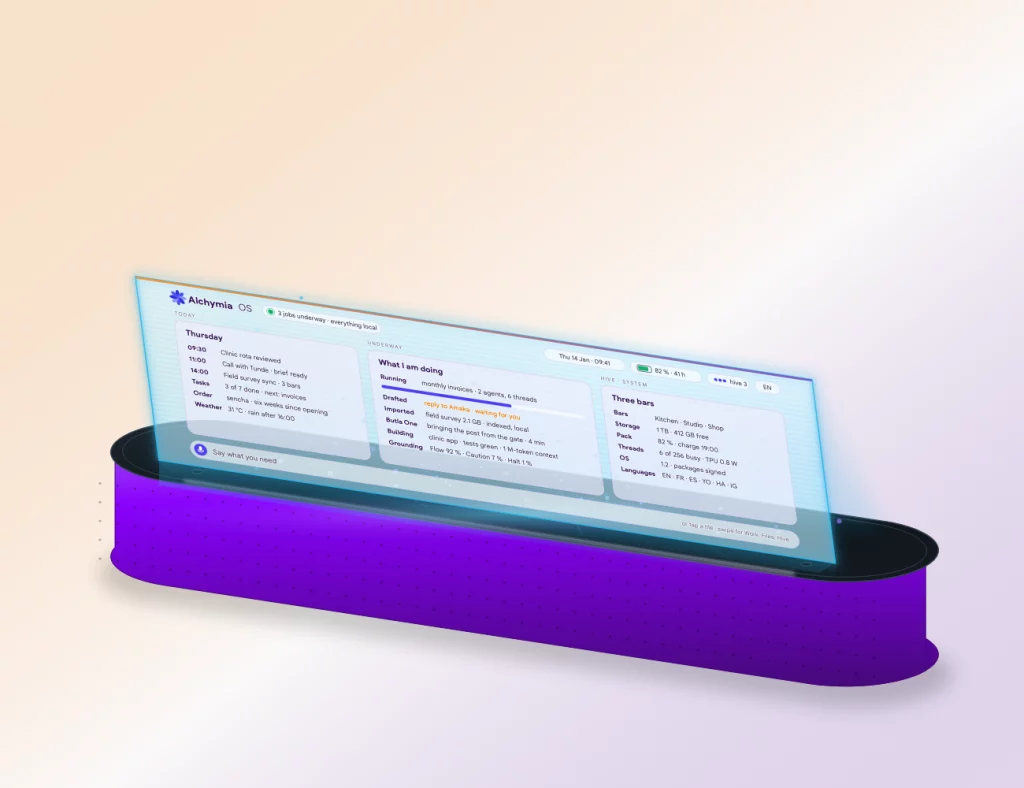
The company is also building its own computer around this idea. Alchymia Bar is a small, screenless computer designed to run the company’s AI locally.
Daniels described it as roughly the size of a Samsung Galaxy phone, and it uses beams of light to project its display, like a hologram.
The projected interface gives users access to applications and allows them to interact with the computer much like they would with a regular machine.
Daniels explained that the computer runs Darkhorse locally and can handle coding, writing, documents, 3D workflows and media.
The computer is still a product in development, with plans to launch it commercially in 2027.
“The computer is not there to replace the normal machine or laptop,” he said. “It is just a starting point to ensure we are going to empower everyone who doesn’t have access to these things just because of where they are born or whatever predicament they are in.”
Alchymia is building towards a world in which AI does not have to remain tethered to the biggest data centres to be useful. Daniels said his focus is on making AI more efficient and available in places where conventional computing has struggled to reach.
“The entire point of why we do this is to ensure we put this technology in everybody’s hand regardless of whether you are poor, you are rich, you have elite education or not,” Daniels said.
True scale demands moving beyond surface-level integrations to robust execution. We’ve filtered the noise out of Moonshot 2026, optimising the conference strictly for high-calibre connections between startup founders, global financial operators, enterprise leaders and individuals rewiring Africa’s technical frameworks. Get 20% off Early Bird tickets for a limited time.
