This article was originally published on TechCabal Insights and was written by Joseph Oloyede, Analyst at TechCabal Insights.
The first half of 2026 is officially over, and the numbers show that African startups had it good funding-wise. Startups across the continent raised a total of $1.44 billion. This is a slight increase from the $1.42 billion raised during the first half of 2025. Even with a tough global economy, this steady growth is a clear sign that investors still believe heavily in African innovation.
The H1 race
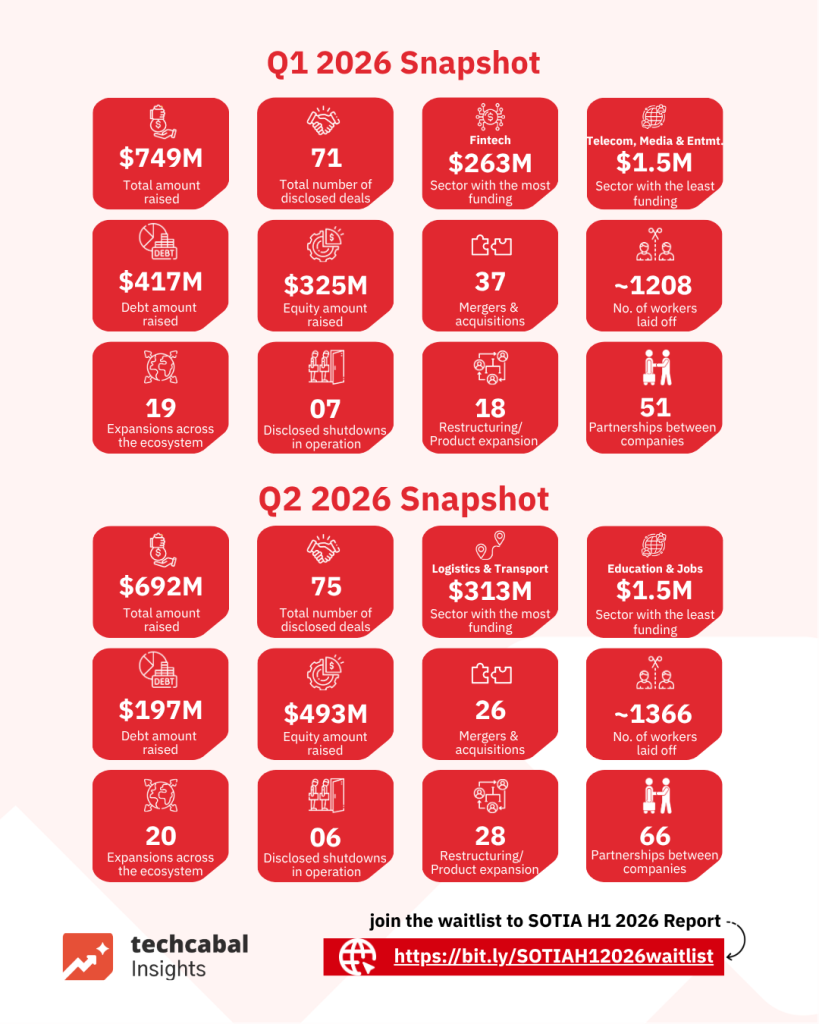
This year is a story of resilience. While the total amount of money raised stayed strong at $1.44 billion, the way deals are happening has completely changed. The biggest story of H1 2026 is that although fewer deals are happening, companies are raising much bigger rounds. We tracked only 146 disclosed deals across the first six months of the year, which is a big drop from the 252 deals we saw in H1 2025.
The momentum really picked up at the start of June. Pan-African electric mobility startup Spiro announced a massive $215 million mega deal on the very first day of the month. This single deal pushed the ecosystem’s total funding over the line, helping 2026 finish the half-year ahead of 2025.
The quarterly mechanics: Equity vs. debt split
A closer look at how startups raised money shows that debt has become a huge tool for survival. Funding was split evenly between the two quarters, with $749 million raised in Q1 and $692 million raised in Q2.
Over the full six months, startups raised $818M in Equity, $614 million in Debt, and $9 million in Grants. This balanced mix shows that companies are choosing to take on loans instead of giving up company ownership, focusing more on stable businesses that own physical assets like electric vehicles and solar equipment.
June’s top deals: Climatetech and big infrastructure stand out
The half-year closed with a massive wave of activity, especially across green infrastructure and AI-backed solutions:
- Spiro is a pan-African electric motorbike manufacturer and clean energy provider that dominated the month by securing a $215 million equity round from Impact Fund Denmark and Equitane, alongside an additional $55 million equity injection from NewTrails Capital.
- Blnk is an Egyptian digital lending fintech platform that raised a combined $37.1 million ($12.5 million in Series A equity and $24.6 million in debt) to instantly finance point-of-sale customer purchases.
- AethexAI is an AI-driven services startup developing localised customer support automation for Africa and the Middle East that secured $3 million in pre-seed funding led by 4DX Ventures and Enza Capital.
- Zimi Charge is a South Africa-based electric vehicle charging infrastructure platform that raised $2.6 million in equity from the Development Bank of Southern Africa (DBSA) and Keyo Ventures.
- Agenz is a data-driven property valuation proptech platform in Morocco that secured a $5M seed funding round from Breega and Attijariwafa Ventures.
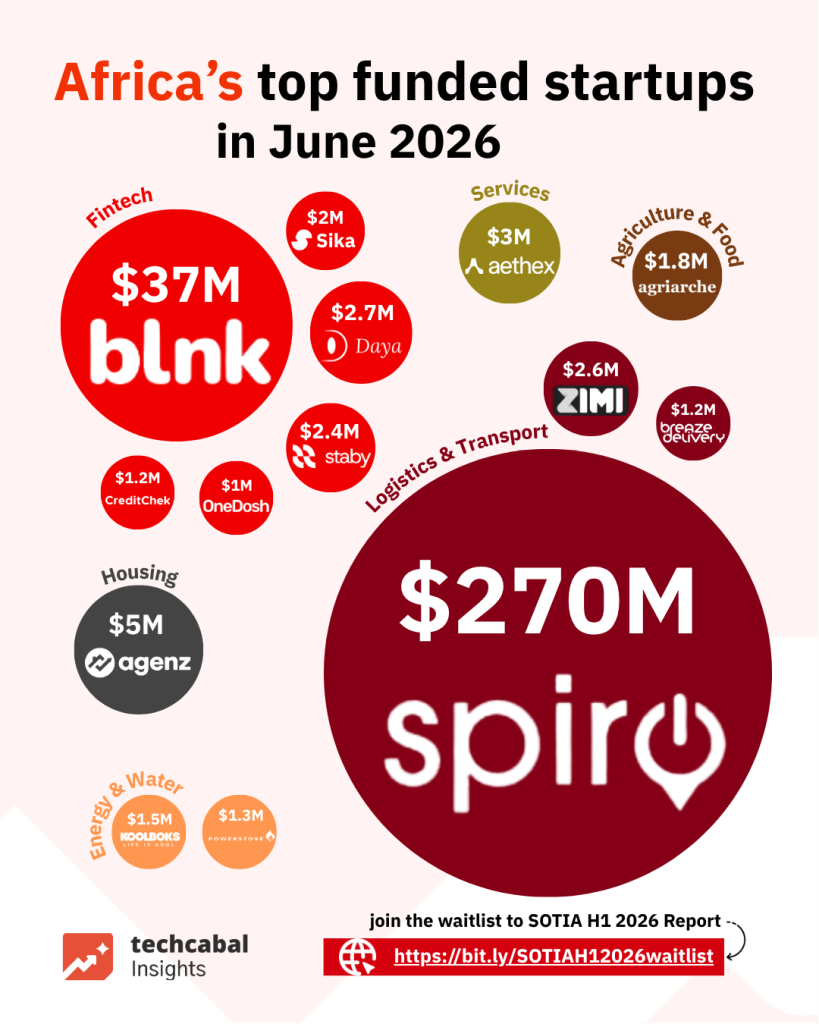
Other notable June activities included major catalytic funding awards from Cascador to green and supply chain platforms, including Agriarche ($1.8 million), solar-freezer provider Koolboks ($1.5 million), and IoT-enabled clean cookstove builder Powerstove ($1.3 million)
A record half for mergers & acquisitions (M&A)
Because getting fresh equity was harder for early-stage startups, many companies chose to buy or merge with each other instead of shutting down. H1 2026 recorded an incredible 63 M&A deals. This is nearly double the 33 deals we tracked in H1 2025, making it the busiest half-year for mergers and acquisitions in African tech history.
This wave of M&A is a major milestone: it creates healthier market leaders through consolidation and opens up vital exit opportunities for investors, proving the ecosystem can self-correct and mature during a funding slowdown.
We saw mature market leaders buy smaller startups to quickly get licenses or enter new countries:
- The payments space: Flutterwave acquired banking platform Mono in an all-stock deal valued between $25 million and $40 million, while Paystack took over Brass and integrated Ladder Microfinance Bank.
- Going global: African startups are expanding outside the continent. Spiro bought UK engineering firm Coexlion, Nigeria’s Nomba acquired a Canadian payment firm, and Yassir bought French ad-tech company Kawarizmi.
- Big money deals: Major corporate moves made waves across the market, including nCino’s $75 million acquisition of South Africa’s DocFox and MNDR’s $119 million deal to buy insurtech pioneer Bima.
The operational reality: Restructuring, shutdowns, and the AI paradox
Behind the big funding numbers, day-to-day operations were all about cutting costs and working smarter. Artificial Intelligence (AI) has moved from a buzzword to a core part of how businesses run. We have tracked over 100 different AI use cases across Africa, mostly helping startups with credit scoring, fraud detection, and automated customer support.
While AI helps companies work faster and cheaper, it has come with a high human cost. As these tools mature, they are moving from helper tools to replacing specific roles. This shift is clear in the numbers: so far in 2026, we tracked over 1,000+ layoffs across the continent, up from 698 layoffs during the same period in 2025.
Companies are now openly citing AI as a reason for downsizing. For example, Jumia cut 200 jobs to integrate AI into its support team, and Zap Africa reduced its team by 44% through AI restructuring. Along with these layoffs, the tough economy caused 13 disclosed shutdowns, but pushed surviving startups to launch 46 product restructurings, 39 market expansions, and 117 company-to-company partnerships to stay afloat.
Join the H1 2026 Report Waitlist here, to see the full list of active investors, average check sizes, regional breakdowns, and where venture capital funds are deploying money next. Join the waitlist for our upcoming State of Tech in Africa H1 2026 Report to get it first.