Millicent Okumu doesn’t leave you wondering whether she believes what she is saying. She speaks with energy, with clarity about whom she is building for. Ask where the company is heading, and there is little hesitation; ask whether she will still be running it in ten years, and the answer is no.
By then, she expects Agriflex, the Kenyan agricultural business she co-founded, to be operating in at least five African countries, to be sustainably profitable, and to be led by somebody else. She might take an advisory role. For now, however, the company occupies even the hours she supposedly spends away from it. At family gatherings, unfinished tasks follow her into the room.
Her father, a civil servant and farmer, raised cattle and grew enough food to support relatives beyond his household. She was close to him, but less enthusiastic about the farm. She avoided agriculture at school and university, only to find herself back in it through a logistics job at iProcure in 2017.
Now she sells farm inputs, deploys spraying drones and listens to farmers explain why a clever piece of technology might be of little use to them. That last part has meant slowing down plans and turning away investors.
“We are in 2026,” she says. “We are no longer in 2006.”
She is impatient for progress, but increasingly particular about what counts as progress, and who benefits.
This interview has been edited for length and clarity.
If I had met you at ten years old and asked what you wanted to become, what would you have said? Would that girl recognise the woman sitting here today?
I wouldn’t have known exactly what I wanted to become, but I was already very determined and ambitious.
I was a daddy’s girl, always following my father around and taking an interest in whatever he was doing. Even when he was discussing serious matters, I wanted to be there. Although I wasn’t the firstborn, I was often the person he delegated tasks to.
I couldn’t have told you that I would end up doing what I do today, but I knew I would be powerful in one way or another.
What did money look like in the home you grew up in? Was it something people discussed openly, worried about quietly, or expected you to go out and find?
Money wasn’t something we discussed openly, but we didn’t have to go out looking for it either. My father was a civil servant who also loved farming. There was enough to take care of us.
That changed when he died, just after I had finished Form Four. Suddenly, I had to go out and find money. I started working at a young age and figuring out how to take care of everybody, including myself.
Money then became something we discussed openly because we had to work out how to make do with the little I was earning.
Your background is in logistics and supply chains. What happened that made agriculture personal enough for you to build a business around it?
Agriculture had always been part of my life. My father had a lot of cattle and land, and farming fed our family, our extended family and even other people in the village.
He was particular about getting certified seeds. He would bring them from Kisumu or travel to Homa Bay town to buy them. We all went to the farm, although I was the one who wasn’t particularly keen on it. My father knew that, but he also recognised that I had other strengths.
In high school, I avoided agriculture. At university, I avoided it again. Then, in 2017, agriculture came calling.
I had been working in logistics when iProcure approached me. The company had raised funding and needed someone to set up its logistics department. I joined in October 2017, and that changed everything.
The work exposed me to so much, and I grew to love it. By the time I decided to leave, I knew I wanted to continue working in agriculture.
Take me back to the first farmer you tried to persuade to work with Agriflex. What did they ask that your business plan hadn’t prepared you for?
To be honest, recruiting farmers and agro-dealers wasn’t particularly difficult because of the relationships we had built at iProcure. People knew us and understood what we could do for them.
But one farmer asked a question that stayed with us: “Millicent and Isaac, you know we need inputs, and you are giving us access to them and advice. But what happens after that?”
Isaac is my co-founder and handles commercial activities and operations. What the farmer was asking us about was the market for their produce. We were supporting production, but the challenges didn’t end there.
That made us think about how we could help farmers find buyers. We now have a plan to support some of them with that. We don’t want to help them through production and then leave them hanging, even as we continue rolling out other parts of the business.
You work with drones and traceability tools. How do you explain what you do to a relative who interrupts halfway through and asks, “But Millicent, what exactly do you sell?”
I start with what is easiest to understand: I sell seeds to farmers and agro-dealers. I also sell crop-protection products, including agrochemicals and foliar feeds. Those are things people recognise and use, even back at home.
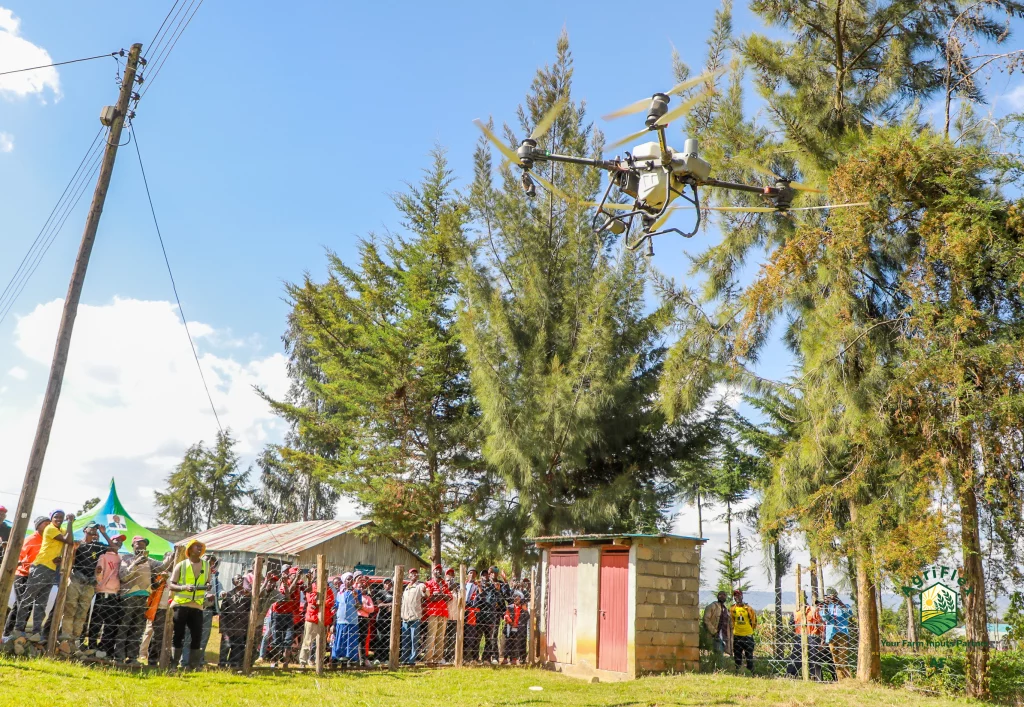
Then I explain that we are helping farmers move away from manually spraying their farms. With a drone, we can spray an acre in a minute. Instead of using 100 litres of water per acre, we can use about 10 litres.
We are making the work easier, reducing the time farmers spend on these tasks and helping them farm more efficiently. We are in 2026. We are no longer in 2006.
Tell me about a time a farmer looked at something you were proud of and effectively said, “That is clever, but it won’t work here.” What did you do next?
That happened with the technology side of the business. Agriflex is technology-enabled, and we have been thinking carefully about how technology can complement our work and improve what we offer farmers.
Initially, we wanted to launch a mobile app with several features, including disease detection and recommendations on which inputs to use.
But when you go out to the farms, you encounter practical problems. The internet connection is poor, or there is no network at all. Many farmers also already recognise the common pests and diseases affecting the crops they grow regularly, such as maize and beans.
They told us: “If this is what your app will do, it won’t solve my immediate problem.”
What they wanted was access to basic, practical information about farming without having to wait for us to organise a training session or demonstration. They were already using WhatsApp. Could we make the information they needed accessible? Could we start there, register them and then build on that relationship?
That feedback made us slow down. We had wanted to introduce the technology immediately, but we listened to farmers and agro-dealers and only rolled it out this year.
It also meant saying no to some investors who wanted technology to be the priority. The feedback from the field was telling us something different, and we decided to follow that.
Who pays Agriflex, and for what? Where does the farmer’s gain end and your margin begin?
Two groups pay us: agro-dealers and farmers. A large proportion of our revenue comes from agro-dealers, whom we supply in bulk.
We want to reach as many smallholder farmers as possible, but we cannot reach all of them directly. Working through agro-dealers allows us to serve more farmers through businesses they already buy from.
Farmers can also walk into our two outlets, in Molo and Ol Kalou, and buy directly from us. Currently, they pay for inputs and drone services. We also introduced soil testing about a month ago.
We negotiate better trading terms with manufacturers, which allows us to offer affordable prices to farmers and agro-dealers while earning a margin.
Trust, reliability and affordability have been very important to us. Agro-dealers need to know that we will supply them reliably, and both they and the farmers need prices that work for them.
What is the most expensive assumption you have made in this business, and how long did it take you to admit it was wrong?
There was a project we took on early in the business that looked very lucrative. On paper, everything suggested it would work. Based on the information we had received and the assumptions we had made, it looked like a good opportunity.
But it didn’t work out as we expected.
It took us three months to agree that we needed to stop. We had to accept that it wasn’t working, cut it off and move on.
When people talk about empowering women farmers, the language can become very polished. Tell me about one woman whose experience forced you to change how Agriflex operates.
There is a woman farmer with about 50 acres that she plants every season. We were supplying her with inputs, but spending time on her farm showed us how much more support she needed.
Spraying even 20 acres involved several workers over several days. She had to be there supervising, and there was a 2,000-litre water tank on the farm. After all that work, the costs were still very high.
It made us ask what the support offered through empowerment programmes actually changes. Does it reduce the time a woman spends on the farm? Does it reduce the resources she has to put into it?
With the drone, we completed the spraying in about 30 minutes.
That experience made us pause and rethink our priorities. Instead of concentrating only on recruiting more customers, we needed to look more closely at how we supported the ones we already had. That applies to our agro-dealers too.
We have also supported her with finding a market for her produce, even though that is not the core of our business.
For me, empowerment means making someone’s life easier in ways they can actually see and experience.
Have you ever walked into a meeting and realised you would have to prove yourself before anyone would discuss your business? How did you handle the room?
Yes. Sometimes people say: “When you said you were Millicent, and we heard what you were doing, we expected someone older and bigger.”
They knew they were meeting a woman, but I still didn’t look like the person they had imagined. Then comes the question: why should they trust that I understand what I am doing?
What has worked for me is knowing my business inside out. I need to understand every aspect of it, including the numbers.
I also draw on my experience. I have done this work before, and I am proud of what I achieved. I am not going into it blindly. I have a blueprint and some understanding of what will work and what won’t.
When you can explain that clearly, people begin to listen. How you carry yourself into the room matters too. They may have arrived with assumptions, but you can give them reasons to reconsider.
What has been your closest encounter with giving up? What happened, who did you call, and what made you return the next morning?
There have been several moments, but I would focus on fundraising. My co-founder and I have considerable experience in the business itself. We understand the work. Funding has been more challenging.
Sometimes conversations progress very well, and you begin to expect a positive outcome. You have plans ready and are preparing to get things moving. Then the feedback comes: “Let’s pause. Let’s wait.”
You find yourself asking: wait until when?
It can leave you feeling so dejected that you wonder whether to continue and why you are doing it at all.
The person I call is always my co-founder, Isaac. I tell him things aren’t going as I thought they would, and we talk through it.
What brings us back is the people we have served. Despite the challenges, there has been so much joy in the journey.
One woman told us that previously, her farm hadn’t produced enough surplus to help with school fees. Last year, after putting aside food for her household, she had enough left to pay school fees for her two children. She was so happy.
Stories like that make us feel we have to keep going.
We also have to remain flexible and adjust quickly when things change. Having a co-founder who understands that we are building for the long term makes the journey easier.
What are you like when things go wrong? If I asked your co-founder, would he describe the same person you are about to describe?
Definitely. He would tell you that Millicent is very tough and very strict. But he would also tell you that I am the most positive person.
When something goes wrong, I am usually the one saying there must be a good side to it. We might not see it immediately, but perhaps we will understand it tomorrow.
Then I move quickly to the next question: what do we do now? We cannot stay in the same place, going over what has happened.
He would tell you I am tough, but also that I am the person who says: “This is temporary. Give it time. Let’s focus on what we can do next.”
What does the business get from you that the people closest to you sometimes have to go without?
My time. The business gets so much of my time.
Even when I am not working, it is at the back of my mind. I can be at a family event and suddenly remember something I was supposed to do.
These days, I keep notes. If something occurs to me when I am doing something else, I write it down so I can return to it later.
I might be somewhere doing something completely unrelated to Agriflex, but Agriflex is still there in my thoughts. It takes a lot of my time and mental energy.
You have received recognition for your work. After the photographs and congratulations, which problem is usually still waiting on your desk? Has an award ever helped you solve it?
The problem is always getting the right inputs to our customers at the right time. Whether I am in the field, receiving an award or speaking somewhere, that need remains.
You can never seem to have enough. The more you can supply, the more customers need from you.
Awards have helped by giving us recognition and credibility. Some investors understand how rigorous particular programmes or award processes are. When they know you have gone through those stages, it can make the conversation easier and the process faster, even if you don’t ultimately get the answer you hoped for.
Recognition has also helped us meet investors who are a better fit. One of our biggest fundraising challenges early on was being in the wrong rooms with the wrong investors.
Some awards and programmes provide continuing support. For example, the women entrepreneurs award we received through AGRA last month comes with support that continues beyond the award itself. These programmes can look at different aspects of the business and recommend things that help us improve.
Some awards also come with money, which goes into the business.
So yes, they have helped: through credibility, connections, financial support and ongoing guidance.
Suppose we meet again over lunch in ten years. What would have to be true about Agriflex, and about your life outside it, for you to say, “Adonijah, this was worth it”?
I think about growth differently now. We want controlled growth.
In ten years, I would like us to be operating well in at least five African countries. By then, I don’t expect to be the CEO.
I want the business to be running fully, with someone else leading it while I perhaps serve in an advisory role.
I would like Agriflex to be recognised in Kenya, across Africa and internationally as a company that has been resilient and become sustainably profitable.
That would give me joy: seeing someone else take the reins and continue building a great business.
True scale demands moving beyond surface-level integrations to robust execution. We’ve filtered the noise out of Moonshot 2026, optimising the conference strictly for high-calibre connections between startup founders, global financial operators, enterprise leaders and individuals rewiring Africa’s technical frameworks. Get 20% off Early Bird tickets for a limited time.
