Timo Lenzen for BI
They're more productive than ever. They're inspired. And some of them are terrified.
Software engineers have spent decades in one of tech's most lucrative and in-demand roles. Now, they're watching their jobs change irrevocably.
In the space of a few weeks late last year, OpenAI, Anthropic, and Google all released new AI models that drastically improved their coding tools. Almost overnight, AI was suddenly good at complex tasks — the kind that used to take humans years to master.
Amy Surrett, an engineer in Greenville, South Carolina, felt the impact of this shift in January when she booted up Anthropic's Claude Code to build a payment feature for one of her company's clients. Coding such a sophisticated project by hand would have taken two or three days, she said. Claude did it in just over an hour.
"It felt like the point of no return," she told Business Insider. "This industry is not going to be the same. My job is not going to be the same."
"The Great Coding Reset" is a multi-part series exploring how AI has sparked an existential transformation in software engineering. Next week, we look at how AI coding has turbocharged some engineers and what it would take to unlock a wider productivity boom.
Follow here to receive an alert about the next piece in the series.
Andrej Karpathy, a former founding research scientist at OpenAI who recently joined Anthropic, wrote in a February X post that it was "hard to communicate how much programming has changed due to AI in the last 2 months." Before December, he said, coding agents "basically didn't work." Suddenly, there was takeoff.
Flash forward to June, and software engineering, a role that employs tens of millions globally, is undergoing a full-blown reckoning. AI is sparking layoff fears, spawning a new lexicon of terms like "tokenmaxxing," and driving hundreds of billions of dollars of AI investments. At tech giants like Google, AI is now writing as much as 75% of the company's code.
Jesse Barber for BI
Whether they like it or not, software engineers are patient zero in a grand workplace experiment. Coding, with its clearly defined rules, has been more prone to AI disruption than other professions, and the lessons engineers are learning could be broadly relevant as the technology begins to disrupt other white-collar work, too.
Over the next few weeks, Business Insider will explore how this shift is fundamentally reshaping the software industry — from its emotional impact on workers to attempts to unlock AI's productivity potential — as part of a series we're calling "The Great Coding Reset."
After all, what does it mean to be a coder if you can build an app without coding? If software engineers don't need to write code directly, what new opportunities arise? And, perhaps most existentially, will the very developers who make and improve these AI tools automate themselves — and the rest of us — out of jobs altogether?
Everything collides
Software engineering has always been an industry of reinvention, long before the release of Anthropic's Opus 4.5 and OpenAI's 5.2‑Codex model this past winter. The dawn of personal computers in the 1970s created a gold rush for talent who could build operating systems and design programming languages.
Those who designed systems for the desktop era scrambled when the internet rewrote the rules, then again when mobile did the same. Now, thanks to platforms like Lovable and Base44, you don't even need to code to build a functioning app.
For many engineers, the pace of change has been invigorating — and also destabilizing. In February, popular engineering newsletter Latent Space launched a spin-off website that epitomized the feeling many technical workers were experiencing. Its name: wtfhappened2025.com.
Kent Dodds left his job at PayPal in 2019 to run a business teaching software engineers. He wanted to build a tool that would let his students download his videos to watch offline, while also encrypting them to prevent unauthorized sharing. In January, he set up an agent with Cursor, an AI-assisted coding tool, which "nailed it on first try," he said. Potentially weeks of work had evaporated in a single morning.
Niki Chan Wylie for BI
"That was my first existential crisis," he told Business Insider.
It wouldn't be his last. Over the past several months, these models have continued to improve, which Dodds said means they are "behaving a lot more like a regular software developer."
"I don't know what the ceiling is, or how fast we're going to hit it, but we certainly aren't anywhere close to it just yet," he said.
'Agents take over the world'
At the AI Engineer Europe conference in London in April, the room buzzed with excitement as engineers tried to make sense of the shift happening under their feet.
"In the last six months, we have seen coding agents take over the world," Ryan Lopopolo, a member of OpenAI's technical staff, said onstage. As he described it, the role of the software engineer was quickly becoming that of an agent supervisor.
Overseeing agents used to be "more of a synchronous process," Alex Ponomarev, the founder of Volt, a boutique software development agency, told Business Insider. "You'd have Claude Code running, it does something, then it stops, you have to tell it what to do next." That's no longer the case, he said.
That doesn't always mean less work. Some engineers have expressed frustration about having to clean up AI-generated code or fix clunky vibe-coded apps built by tech-novice coworkers.
With more time spent managing agents and less time in the code, some developers' schedules look different, as they restructure tasks around creating specs for AI and take breaks while their token limits reset.
"It's basically not even worth my time to be manually writing code when I can have something like Claude doing it for me," Danial Qureshi, a software developer in Toronto, previously told Business Insider.
What to build — not how to build
The catch, of course, is that this extraordinary new power is nobody's secret weapon. If you have it, so does everyone else, and it's getting harder to compete against the bots. In response, engineers are doubling down on their distinctly human qualities.
Niki Chan Wylie for BI
Over the last year, Dodds said the number of questions he receives from students has seen a "drastic decline." He chalks it up to coding agents' ability to answer those queries much faster.
Where Dodds not long ago would teach engineers how to code, today he has a new curriculum for what he calls "product engineering" — a focus on what to build, not how to build it. The value of humans, as Dodds sees it, is judgment. What problems should be solved? What are the benefits and drawbacks? What would be truly useful to the user?
"I'm teaching the last skill that the last software engineer needs to have," he said.
Similarly, Surrett is reckoning with how her job has changed. She graduated with a Bachelor's in software development in 2022, just a few months before ChatGPT launched. AI has fundamentally changed the way she expects to use her education. She estimated that AI tools were writing 5-10% of her code a year ago and said it's now around 80-90%.
Jesse Barber for BI
"It's a double-edged sword, because in some ways I'm getting more done but also doing less work, so it feels less productive," said Surrett. While she worries about the implications on an industry she is still fresh to, she still thinks she has an edge. "I know patterns of writing good software that someone who downloaded Claude Code last week won't know."
Plus, she's sharpening other skills. "I'm leaning on some of the soft skills AI can't really replace," said Surrett. "Figuring out how to phrase things, what a client wants, having that creativity."
Still, it's impossible to ignore the forces reshaping tech, as companies cite AI in rounds of sweeping layoffs while doubling down on massive AI investments.
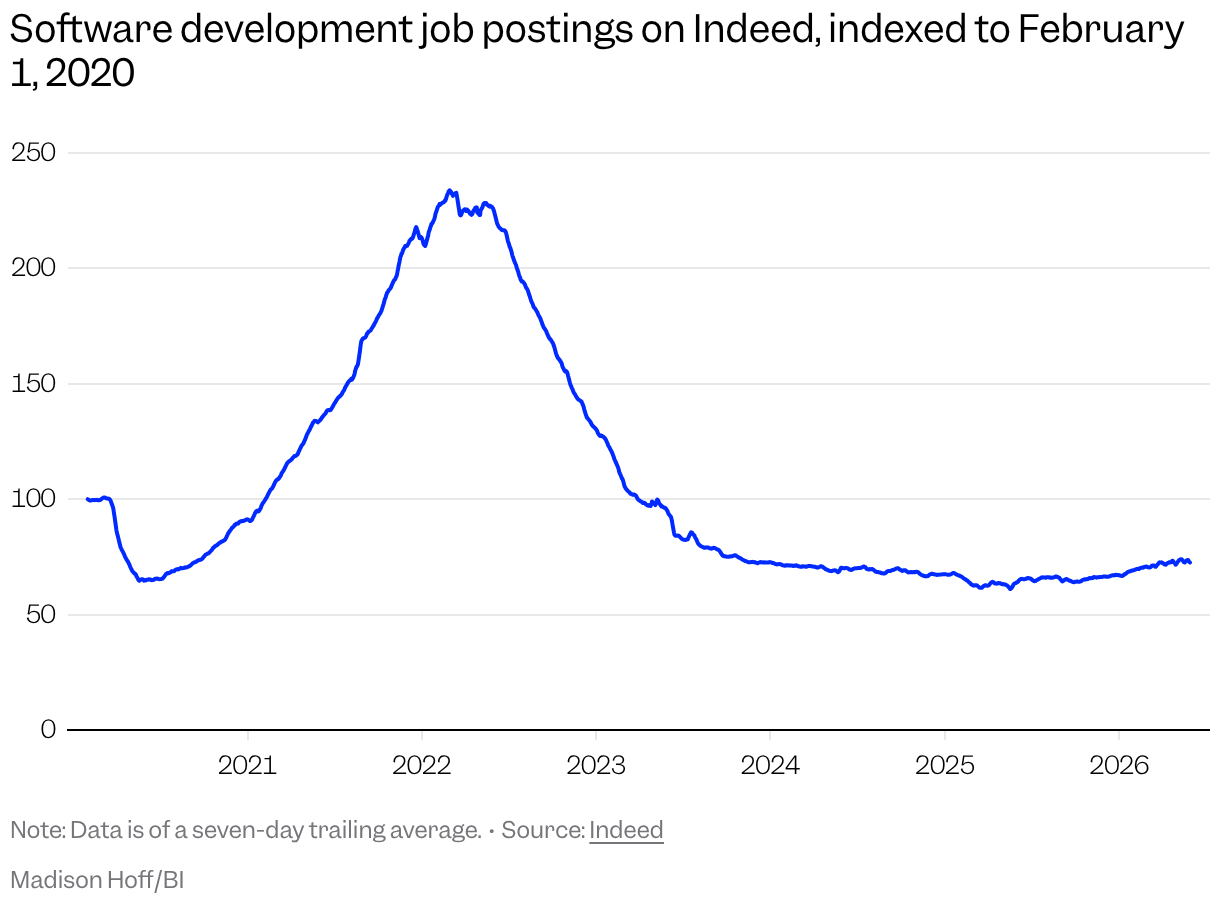
Until recently, software developers have been relatively shielded from layoff fears. That perception has changed, though recently there has been a modest uptick in software engineering job postings, according to data from job site Indeed. With AI producing more code than ever, more humans could be needed to oversee it.
One person who isn't worried about AI is Jason Young, an engineer of 30 years. He's leaning into what sets him apart from the bots.
"A couple years ago, I felt very threatened," said Young, now a lead engineer at smart kiosk maker ChargeItSpot, of the agents he's been experimenting with. Yet the more time he's spent with them, the more confident he's become that human judgment will remain crucial.
For Young, the essence of engineering is in understanding the problem, not mass-producing lines of code.
"The writing of text — that isn't what being a software engineer is," said Young. "Anyone who thinks otherwise has a wild misunderstanding of software engineering."