When Zimbabwe went into lockdown in 2020, some people turned to baking, binge-watching television, or scrolling social media. Courage Nyoni taught himself how to code.
The civil engineering graduate spent months watching online tutorials before building his first app, a study aid for sociology students at Zimbabwe’s Bindura University. But it was his second project, an Android app that calculates lobola/dowry, the bride price traditionally negotiated between two families before marriage in many Southern African cultures, that unexpectedly travelled much further than he ever imagined.
Nyoni’s Lobola Calculator, housed on the Google Play Store, has attracted users across Southern Africa, Europe, and even Japan, where it was featured on national television. The Calculator may look like a novelty app, but it reflects a broader trend. Across the continent, developers are increasingly building software rooted in African traditions and languages.
From digital ancestry platforms to indigenous language apps and now a Lobola Calculator, culture itself is emerging as a competitive advantage, one that only African founders can authentically encode into software.
That is exactly what happened with the 26-year-old Zimbabwean developer’s app. “The concept actually originated from a light-hearted conversation with my brother, Charisma,” Nyoni told TechCabal in an interview. “We laughed about it initially, but quickly realised it was a fun and doable project.” He said he deliberately avoided building another fintech or delivery app.
“Coming from a Civil Engineering background as a self-taught developer, I wanted to be strategic with my early projects,” he said. “A conventional delivery or finance app would have required massive backend infrastructure and investment. The Lobola Calculator was the perfect project to tackle. It solved a unique, real-world cultural need, didn’t require major funding to publish, and allowed me to build my development confidence without overextending myself.”
More than a joke
Lobola is a customary marriage practice observed in many Southern African communities in which the groom’s family presents gifts, cattle, or money to the bride’s family during marriage negotiations. While often simplified as a “bride price,” families generally view it as a symbolic expression of appreciation, respect, and the joining of two families rather than a commercial transaction. Nyoni’s app doesn’t attempt to replace that process. Instead, it turns it into an interactive experience.
Users answer questions ranging from educational qualifications, country of origin, and totem to deliberately playful questions about childhood breakfasts, footwear preferences, and whether weekends are spent at church or at clubs. Behind the scenes, an algorithm adjusts a fictional lobola amount using weighted variables.
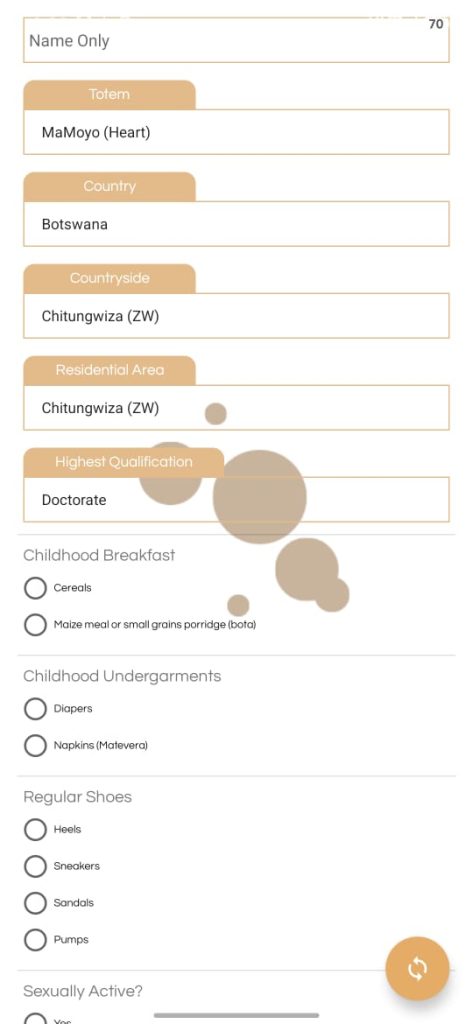
“I didn’t just want a random number generator,” Nyoni said. “I wanted it to reflect the actual conversations happening in our communities.”
He said he researched common cultural considerations and consulted elders before building the algorithm. “The app essentially gamifies those real-life dynamics,” he stated. “It’s a fun, digital mirror held up to the real negotiation room.”
What began as lockdown entertainment soon became something else. “When I first built it, it was definitely just for fun,” Nyoni said. “The lockdowns had taken a toll on everyone. Dropping something light-hearted like the Lobola Calculator into the mix seemed like a great way to spark conversation.”
Then the app began attracting attention far beyond Southern Africa. Emails from users in Europe started landing in Nyoni’s inbox, not about bugs or new features, but with a simple question. “A few months after release, I started getting feedback from users in Europe asking what Lobola actually was,” he said. “That was a turning point.”
He responded by adding educational content explaining the custom. Today, the main goal is simply to preserve our tradition, help people across the globe learn about Lobola, and still have a bit of fun with the calculations.”
African culture as software
Nyoni believes the app points to a much larger opportunity for African developers. “I absolutely believe African traditions are an untapped opportunity,” he said. “As the world becomes more digitised and people spend more of their lives on screens, there is a massive opportunity to build software that reflects how we actually interact offline.”
Lobola Calculator is part of a wider movement across African tech.
In Ghana, language-learning platform Kukarella helps users learn African languages through interactive lessons and conversation practice. African Storybook, developed in South Africa, has created a free digital library of thousands of children’s stories in dozens of African languages.
Similarly, developers are building African language keyboards, genealogy platforms, digital ancestry tools, traditional medicine apps, and local naming applications, products whose value comes from cultural knowledge rather than technological novelty alone.
He argues that Africa’s social systems are full of products waiting to be built. “Imagine fully digitising the popular Stokvel system in South Africa to make it more secure and scalable,” he said. “That is a massive untapped market. We have a rich cultural heritage, and if we pause to think in other terms, we can see vast digital opportunities right in front of us.”
A stokvel is an informal community-based savings group in which members contribute a fixed amount of money weekly or monthly, and the funds are either paid out to one member on a rotating basis or pooled for a shared purpose.
Curiosity travels further than code
The biggest surprise for Nyoni was not Zimbabwean users. “Most of the active users are based in the Southern African Development Community (SADC) region, which makes perfect sense,” he said. “However, the demographic that surprised me the most was people with little to no connection to Africa. The way they interacted with the app was purely driven by curiosity.”
On June 10, the curiosity reached Japan when Nyoni’s app was featured on Nippon TV, one of the country’s largest commercial broadcasters. “Taking a deeply rooted African tradition and packaging it into a modern mobile app makes it incredibly accessible,” Nyoni said. “It allows someone thousands of kilometres away to safely and interactively explore a piece of our heritage right from their smartphone.”
In a statement celebrating its alumnus, Zimbabwe’s National University of Science and Technology (NUST) described Nyoni’s journey as evidence that “innovation can emerge from the most unexpected circumstances”. It said his story demonstrated “the transformative education that NUST provides.”
However, not everyone welcomed the idea. He revealed that some elders were worried the app trivialised an important custom. “Many embraced it as the fun and educational tool I intended it to be,” Nyoni said. “However, some did express concern that it oversimplified a deeply sacred practice.
He explained that to elders, lobola is not simply a financial transaction but a sacred customary process that formalises the union of two families and honours the bride’s upbringing. The negotiations are guided by elders, who safeguard cultural values, respect, and family relationships.
An app that reduces the process to an algorithm or calculation can therefore appear to oversimplify a deeply symbolic tradition. He agrees the distinction matters.
“The app is meant to be a digital icebreaker and an educational window,” he said. “It could never replace the profound cultural weight and family connection of the actual, real-life negotiations.”
Building with culture instead of disrupting it
Like many independent developers, Nyoni earns modest passive income through Google AdMob advertising, deliberately avoiding subscriptions so the app remains free. If funding became available tomorrow, however, his wishlist says much about where he believes African software should go next. A secure digital stokvel platform tops the list, followed by an interactive app preserving ngano (folklore), folktales that grandparents told around the fire, featuring traditional characters.
Underlying both ideas is the same philosophy. “Silicon Valley’s traditional model is mainly all about disruption,” Nyoni said. “What I learned from building the Lobola Calculator is that when you are dealing with African culture, the goal isn’t disruption; it’s preservation.”
He added: “You can’t just ‘move fast and break things’ when you are handling a sacred tradition or our elders’ legacy. You have to build software that acts as a bridge rather than a replacement.”
True scale demands moving beyond surface-level integrations to robust execution. We’ve filtered the noise out of Moonshot 2026, optimising the conference strictly for high-calibre connections between startup founders, global financial operators, enterprise leaders and individuals rewiring Africa’s technical frameworks.
Get 20% off Early Bird tickets for a limited time.